

EXPECT INCREMENTAL IMPROVEMENT IN SA’S ECONOMIC MOMENTUM, 24Q3
The newly installed Government of National Unity (GNU) has re-ignited hopes for an economic revival. Economic growth tended to be erratic and lacking momentum after it rebounded from the COVID-induced slump in 2020.
The first GDP release following the ground-breaking national election (29th of May), 30 years into SA’s democracy, showed that, compared to (a slightly upwardly revised) 0.7% growth in 2023, the economy slowed during the first half of 2024.
Real GDP was flat in 24Q1 (the first estimate was for a small contraction of 0.1%) and expanded by only 0.4% in 24Q2. This release, combined with the available third quarter economic indicators, delivered no real surprises, except by accentuating the brokenness of the SA economy, and providing proper perspective in terms of any revival going forward.


There were two encouraging features in the 24Q2 GDP release. Firstly, real domestic expenditure picked-up notably (1.4% qoq); and, secondly, output in the water & electricity sector grew the strongest (expanding by 3.1% qoq and 5.3% yoy; during 2023, it contracted by 4.0%). Restored growth in electricity output had a direct and indirect positive impact on secondary sector GDP, growing by 1.3%, in line with the growth registered in the fastest growing tertiary sector, i.e., financial and business services.
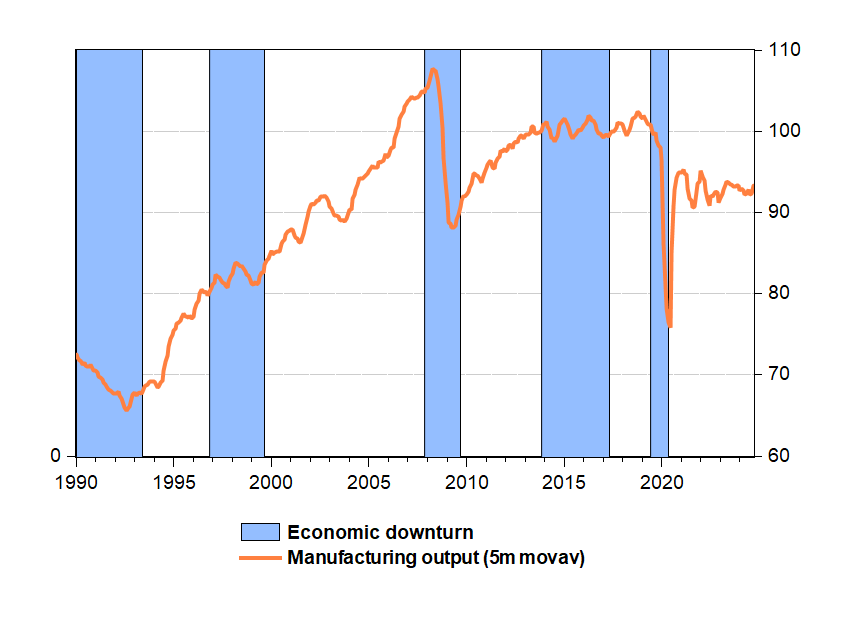
The recovery in the secondary sector, i.e., manufacturing (picking up 1.1% qoq), construction (0.5%) and the utility sector (3.1%), will represent an important change in the economy should it be sustained[1]. The reality is that the secondary sector lags the post-covid general economic recovery. Despite the 24Q2 uptick, the sector is down 1.4% compared to a year ago and close to 10% beneath levels prevailing in 2019 before the COVID-19 pandemic impact.
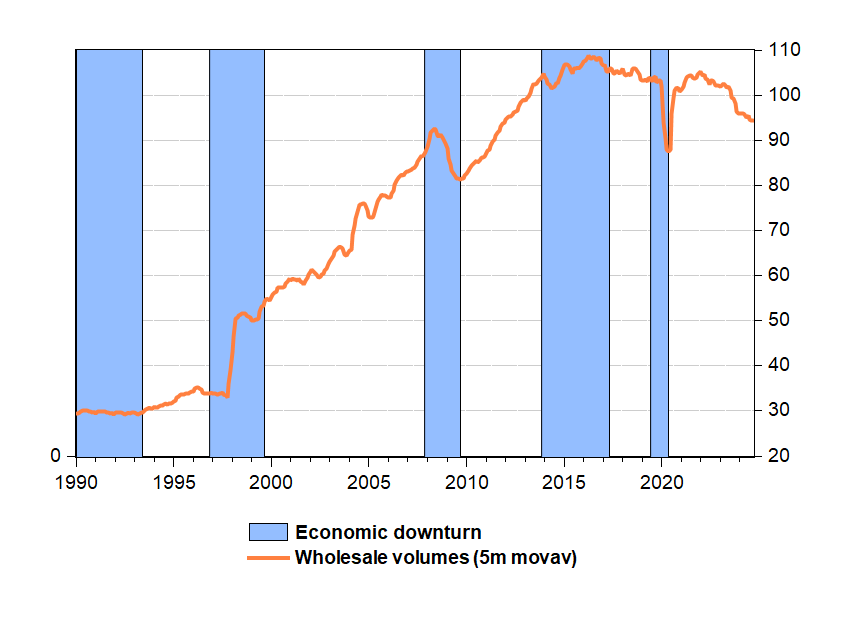
Excluding agriculture, it is most significant that that the cyclical sectors, ranging from mining (-0.7%) to manufacturing (-1.4%), retail, wholesale & accommodation (-1.8%) and construction (-7.3%), remain down on levels a year ago, despite renewed growth in each during the second quarter of 2024. On the downside, this explains the weak momentum in the economy, on the positive side, the scope for recovery (and catch-up).
Real agricultural GDP contracted in 24Q2, but following the sharp jump in Q1 and the bumper 2020/22 seasons, the level remained 18% above that of 2019 (pre-covid), i.e., the strongest growing sector over this period. The agricultural sector has important backward (and forward) linkages in the wider economy.
The BER’s 24Q3 business opinion survey results serve as a timely reality check. As noted, the business mood lifted only modestly (by three index points to 38), despite the ‘end’ of loadshedding and the positive election outcome and subsequent formation of the GNU. While it is evident that the building blocks for a more meaningful recovery over a 12-month time horizon are moving into place, the economic recovery faces formidable hurdles.
Twelve-month expectations became more upbeat and survey respondents’ rating of the general political climate being a constraint on business and investment activity eased notably. This bodes well, as real domestic fixed investment is strongly correlated with the inverse of this indicator. Should the change in economic momentum be sustained, with lower inflation and interest rates ahead, business confidence may lift further, which will then translate into higher investment.

It should be emphasized that the economic recovery underway will be less reliant on household demand conditions leading the way, given the elevated level of pent-up demand in the private sector. Autonomous fixed investment spending may be an important driver. The civil construction sector and even building activity in the non-residential sector are likely to experience an improvement and the BER’s third quarter survey results indicate this. It is also encouraging that real household spending kicked-up during 24Q2, acting as a stimulus for business activity.
Public-private sector partnerships (PPPs) will become an important feature of the economic landscape, as will increased foreign direct investment and capacity expansions in leading industries. Employment and the associated income generation will provide an important feedback loop in the economy, driving household spending even higher and therefore general confidence.[2]
For now, how real these prospects may be, it is also clear that the economy is recovering from a most disadvantageous vantage point. The detail of the 24Q2 GDP statistics and the available 24Q3 economic indicators portray this. At the centre of the malaise is a broken manufacturing sector (see chart).
For economic growth to accelerate more meaningfully, will require concerted economic policy action and real progress in addressing the teething problems faced by the new GNU. The odds are stacked against SA, but as in the past, the economy (and body-politic) is known to be resilient. Coming to terms with coalition politics will be a long-term project. In the interim, visible progress is required. This interaction is not uni directional as higher economic growth will also have a positive impact on political socio-economic relations.
A further lift in business confidence and improved household spending are critical as the export sector are likely to suffer weakening demand over the near term. The jury is still out regarding the US economic cycle, but it is fair to assume that even should the US (and world) economies slow down, that it will be mild. The major risk factors are geo-political tensions and the ongoing wars in Ukraine and Middle East, as well as international financial market instability and climate crises.
Domestically, demand conditions are weak as we exit the tightening interest rate cycle. Inflation is projected to fall more significantly in the months ahead, which will prepare the way for lower interest rates. The uptick in real household spending (1.4% qoq) and broader, domestic expenditure (1.1%) are encouraging signs, albeit that it is difficult to assess whether this is simply part of the well-established pattern of erratic economic growth. Both household and aggregate domestic spending remained down on levels a year ago (-1.1% and -1.7%, respectively), reflecting the weak demand and general lack of economic momentum.
The most worrying factor considering domestic demand, is private sector fixed investment spending, which is 7.7% below levels a year ago and, when inventory investment and public sector capital spending are included, real gross domestic fixed investment is down close to 12% compared to levels prevailing in 2019 (pre-covid).
As noted, a sustained, strong recovery in this variable remains critical for the economy to regain momentum. This, in turn, will require sustained breakthroughs on the socio-political front and concerted policy action in creating conditions conducive to private sector fixed investment and employment creation. Autonomous public-private fixed investment projects are likely to be a key ingredient, strengthening the investment and employment creation drive.
In sum – the SA business cycle[3]
Business confidence has ticked up during the first half of 2024 to a level where close to four out of every ten survey respondents report satisfactory business conditions. Combined with the fact that 12-month expectations regarding general business conditions lifted notably in 24Q2, this is a meaningful indication that the economic recovery is likely to strengthen.
There are two important caveats. Firstly, manufacturers indicated that export sales were 0.4% down (qoq, 24Q2) and 1.9% (compared with levels a year ago). This reflects, inter alia, slower export demand, i.e., a weakening in world economic growth. Domestic economic policy action and autonomous capital spending in the private and public sectors, therefore, must be more concerted.
Secondly, as the domestic manufacturing sector’s capacity has been hollowed out over the past two decades, increased domestic spending (by households, the government and business) will result in higher imports. StatsSA’s 24Q2 GDP release revealed that imports kicked-up (1.7% qoq). There may be scope for active industrial policy initiatives in improving SA’s manufacturing base, and thereby improving its export effort in time as well as by replacing imports. In this regard, addressing SA’s logistics infrastructure constraints remains critical.
It is evident that renewed business cycle momentum will be heavily dependent upon the appropriate structural economic reforms being implemented. Potent policy initiatives are already on the table, what remains is for those to be implemented with speed[4].
The incumbent economic recovery will be shaped amidst serious teething problems in the post-election GNU and an unstable geo-political climate. From experience, we also know that macro-economic structural reform policies often require upfront sacrifices (analogous to a health crisis before healing occurs). It is almost inconceivable expecting more sacrifice from SA’s citizens.
Unfortunately, there are no short-cuts in restructuring the economy. A populist spending spree may well satisfy the citizenry but is sure to end in tears as the balance of payments blow out in 24-36 months, given SA’s hollowed-out manufacturing sector and the high import intensity of domestic spending.
In view of the political tightrope, the prevailing geo-politics and domestic structural reform, the immediate road ahead will remain tough, but the medium-term benefits are real.
US economic resilience a bedrock for the world economy
Whereas US politics are in disarray, overshadowed by deep division, the economy experiences the proverbial sweet spot of resilient growth. Inflation is nearing the Fed’s target, and the labour market remains firm, albeit that unemployment has risen from a cyclical low of 3.4% to 4.2%. This has now moved into the Fed’s focus.
Real GDP has consistently been expanding at a 3% pace (yoy) from mid-2023. The resilience has been underpinned by a virtuous circle of robust private fixed investment spending, an attendant strong labour market and confidence-inspiring household demand conditions. The latest high-frequency economic indicators show that fixed investment is starting to cool down, as is non-farm payroll employment.
The Fed’s bold decision to cut the funds rate by fifty basis points acknowledges the softer labour market and spending conditions, as well as the possibility that they should have moved in July already given the time lags involved in the monetary transmission mechanism. From this angle the bolder than expected move was appropriate.

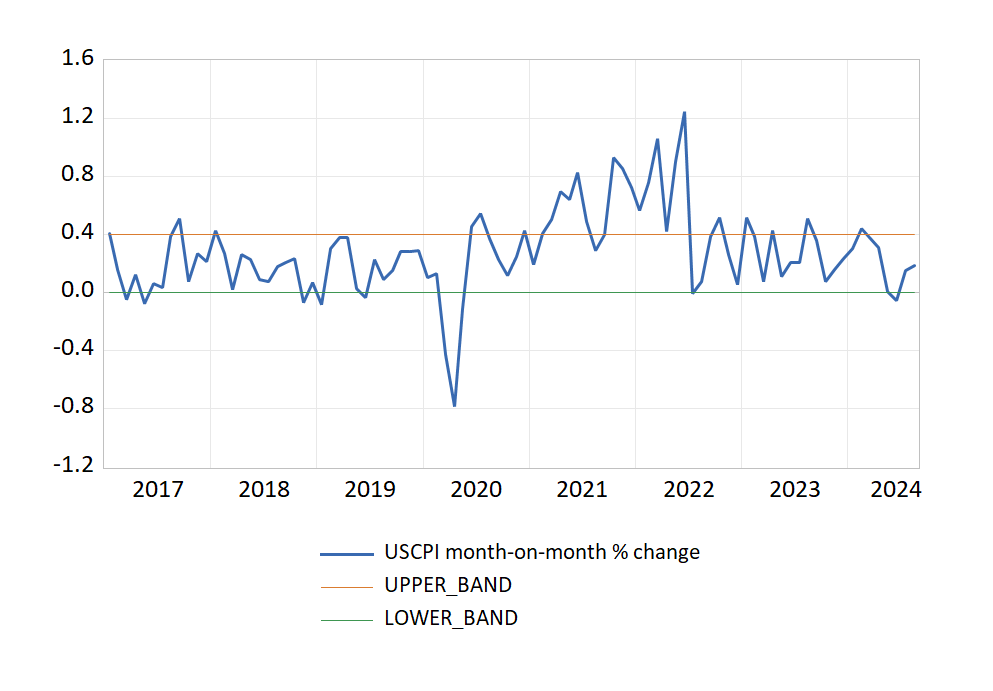
Disinflation is on a firm downtrend and the bigger risk has become increased unemployment.
In this way, the Fed has effectively dealt with the risk of ‘interest rates staying too high for too long’ the expectation is for another fifty basis points cut in November. A resilient US economy is sorely needed in the current global geo-political environment of traumatic conflict and high uncertainty. It provides a bedrock for the world economy to continue expanding close to a trend rate. This is BCA’s expectation.
[1] Energy experts confirm that the improvement in the electricity generation industry is real, albeit that risks remain. The focus in restoring electricity supply is now shifting to municipalities that remain critical actors in the distribution of electricity generated by Eskom. See Jacobs, S (11 May 2024) South Africa’s next electricity crisis. [online] https://mybroadband.co.za/news/investing/536293-south-africas-next-electricity-crisis.html). Furthermore, the sustained ramping up of renewable energy remains critical.
[2] The BER has ascertained in research of the underlying drivers of its survey respondents’ answers to the survey questions that general demand conditions are the most principal factor driving business confidence.
[3] BCA hereby wishes to acknowledge that the recession-dating algorithm was designed and developed at the BER, Stellenbosch University.
[4] BER Comment (June 2024): Redefining South Africa’s economic trajectory: how structural reform can lift South Africa from its slump. [online] chrome-extension://kdpelmjpfafjppnhbloffcjpeomlnpah/https://www.ber.ac.za/Documents/ViewMode/fd5a6f16-1ad0-4663-8949-6fb08c00ce0c
“When you adopt a cyclical worldview, your outlook will be in the minority whenever the chance of an economic turning point is high”.
Achuthan & Banerji