

SA ECONOMY ON THE BRINK OF A HISTORIC TURNING POINT, 24Q2
Readers have become conditioned with gloomy SA economic news. To be true, the current post is no exception in reporting on the state of the business cycle in 24Q2. The week following the country’s national election (29th May) brought profoundly inspiring news as SA embarked on a new chapter of its economic history as its democracy deepens, with the effective end of the one-party dominant state (commencing 30 years earlier in April 1994). This is already fact.
The new government is still being forged at the time of writing, but the prevailing political forces are such that the constitutionalists are teaming up in a Government of National Unity (GNU), whilst the so-called revolutionaries (read: non-constitutionalists) are rapidly writing themselves out of history. This is an unambiguous boost for business and consumer confidence – watch this space (in qualitative economic indicators to be published over the coming months).
Real GDP contracted marginally during the 24Q1 (0.1%) compared to 23Q4 but is still up 0.6% year-on-year, in line with the momentum of 2023. The contraction was sharper (0.4%) when the rebound of the agricultural sector (up 13.5%) is excluded. An important feature of real economic growth is the weakening of demand conditions, both domestic and externally.
The consumer is under pressure (high and increasing unemployment, high inflation and interest rates and deep uncertainty). The private sector has been on the sidelines regarding fixed investment spending, except in the renewable energy sector, where investment activities have been livelier. Erstwhile robust export growth is also waning in the face of weaker global demand (see below).
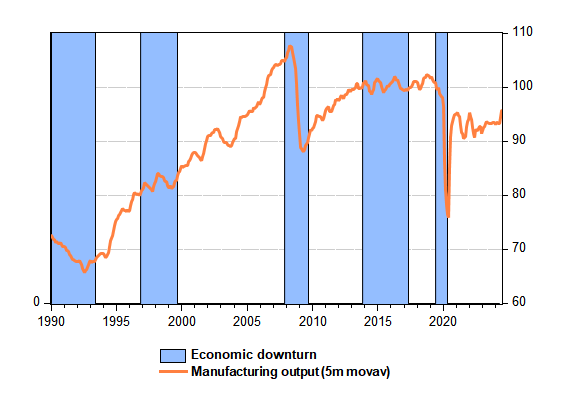
On the supply-side, the services sectors moved sideways during the first quarter of 2024 (with only transport & accommodation contracting sharper, by 0.5% quarter-on-quarter). The strong rebound of agricultural GDP assisted to counterbalance the contraction of not only mining (2.3%), but also of the secondary sectors, manufacturing (1.4%), construction (3.1%) and water & electricity (0.4%). As noted, the agricultural sector added 0.3 percentage points to quarterly real GDP growth in 24Q1.
In year-on-year terms, primary sector GDP is 3.1% down, as well as secondary sector GDP (-1.2%). This was fully counterbalanced by 1.3% growth in services activities (personal services, 3.3%; financial services, 2.4% and transport & communication, 1.8%), resulting in a modest 0.6% expansion in overall real GDP. This positive contribution by the services sector faded in recent quarters in line with the weakening overall demand conditions. This is also reflected in the only services sector contracting in year-on-year terms, namely retail, wholesale, and accommodation (3.5%).
The demand side of the economy, the largest expenditure sector, real household spending, contracted by 0.3% in 24Q1. Combined with fixed investment spending (including inventory investment), the quarterly contraction in real domestic spending (GDE) was a full percentage point, bringing the year-on-year contraction to 1.6%. The weakening trajectory of broader spending in the economy already commenced mid-2022.
Of concern is the sharp contraction in private sector GDFI in 24Q1 (3.3%), reflecting weaker spending in the renewable energy sector, which has been an important driver of fixed investment from end-2021. Of some consolation is the growth in public sector fixed investment in 24Q1, which is corroborated by the BER’s business opinion survey of the civil engineering sector. Overall real GDFI is close to 3% down in year-on-year terms and 10.8% lower compared to pre-COVID levels. The lack of fixed investment spending is the prime reason for the lack of any cyclical momentum in the economy.
Exports of goods and services also contracted in 24Q1 (2.3%), with the downward momentum accelerating – the level of exports is 0.5% below that of a year ago. However, as imports are contracting in association with domestic spending, net exports remain positive. In the first quarter net exports compensated fully for the contraction in final demand (2.0%, consumption by households and the government, as well as private and public sector fixed investment spending).
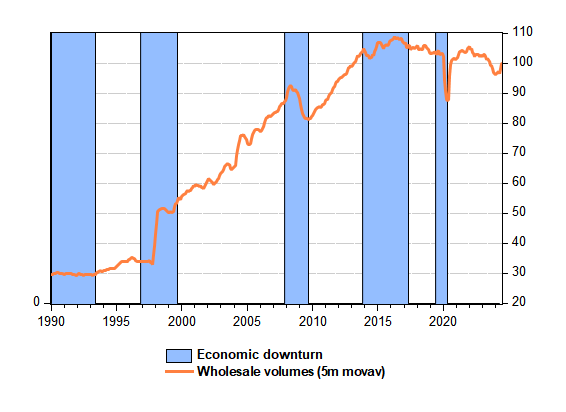
Second quarter economic indicators confirm a measure of resilience in domestic spending, with some sectors of household spending continuing to grow (e.g., non-durable goods); spending on services have cooled down and contracted in 24Q1. Manufacturing fixed investment also showed growth, while the property sector pipeline has turned positive given interest rate expectations. Civil engineering contractors are also reporting greater optimism regarding big public and private sector projects. The sustained contraction (albeit decelerating) of passenger car sales and wholesale sales volumes are worrisome as both indicators are important on the demand side of the economy.
In sum – the SA business cycle[1]
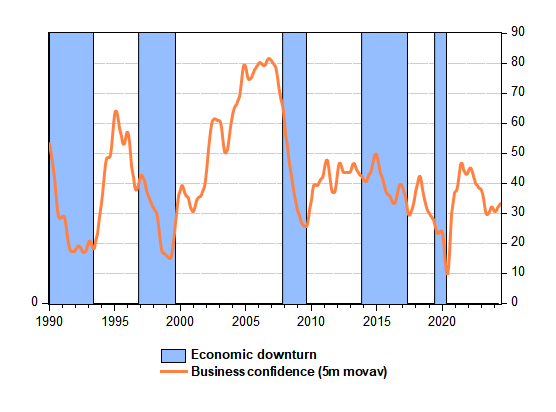
The SA business cycle has lost real momentum, having little thrust. The rigidity of the economic cycle continues. Whilst overall business confidence rebounded by five index points (the RMB/BER Business Confidence Index jumped to a level of 35), it still implies that close to one third of business executives report unsatisfactory business conditions. Business confidence recovered from deep negative territory in 20Q2 (at 10 index points) but has since not breached the neutral level of fifty.
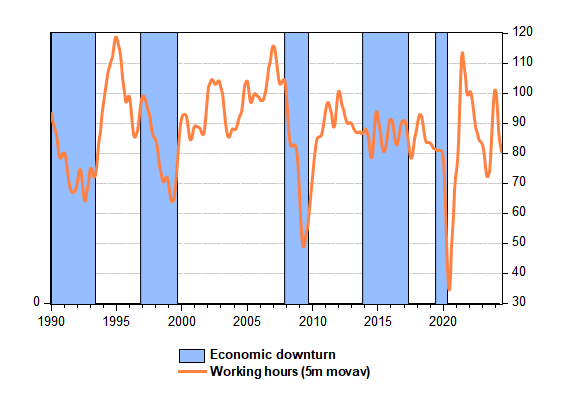
As noted, gross domestic fixed investment was still 10.8% down in 24Q1 compared to 2019 levels. Whereas inflation has receded to 5.2% in April/May (core CPI, 4.6%), interest rates remain at peak levels (prime rate at 11.75%). Broad consumer spending is under pressure in this hostile financial environment, owing to the lack of employment and income generation and elevated levels of uncertainty.
Real GDP growth has been erratic, being impacted by intermittent electricity shortages, socio-political unrest, and flooding. Hopefully the second quarter will see relief regarding electricity supply, albeit that this was not so evident in the BER’s 24Q2 business opinion survey.
Unplanned electricity blackouts remain evident at sub-stations owing to strained infrastructure, which hampers production. Furthermore, elevated levels of uncertainty reigned in the run-up to the national election (29th May), exacerbated by serious geo-political tensions (the Russia/Ukraine war; the Middle East and the South China Seas).
The SA election outcome is unambiguously positive for business confidence. Governance in a GNU will remain choppy, but the historic moment, combined with the measure of resilience in domestic spending, as well as world economic growth, led by the US economic performance, provides a platform for faster growth. Substantial pent-up demand exists in the private sector, which will be unleashed in a favourable political climate.
Unfortunately, SA remains exposed to external risk should the US economy stumble and, domestically, the country is walking a political tightrope.
US ECONOMIC OUTPERFORMANCE AND RESILIENCE CONTINUES
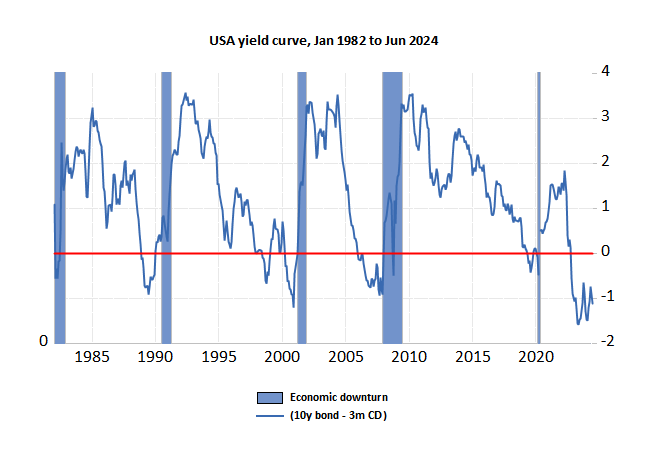
US real economic growth has decelerated over the past three quarters, from 4.9% (annualised) in 23Q3, to 3.4% in 23Q4 and 1.6% in 24Q1. The question is whether the US economy is headed for a recession? The yield curve inverted more than 12 months ago, retail sales volumes have slowed down as real disposable incomes took a dip (partly owing to higher inflation and interest rates) and with high debt levels constraining growth.
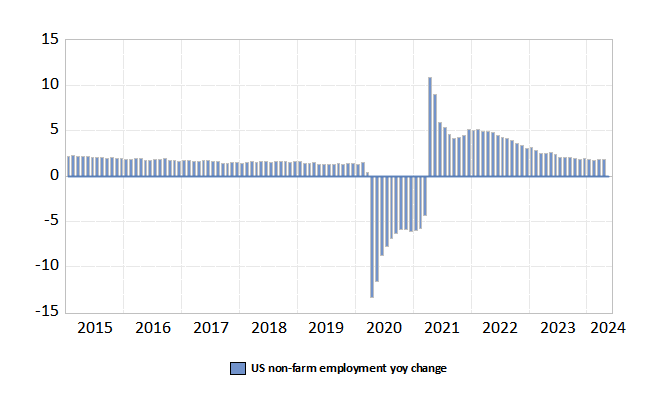
The inversion of the yield curve may only have signalled a modest slowdown as the labour market remains strong (see chart) – the growth in non-farm payrolls has flattened, but continues and, as a result, the slowdown in real disposable incomes and retail sales appear to be bottoming-out. Yes, the consumer is under pressure from high interest rates, but the resilience of the labour market ensures sufficient income growth, allowing the consumer to lessen debt burdens and/or to incur new debt.
The same cannot be said about the government. The level of government debt is close to the official debt ceiling of $31.4 trillion and the worry is that the ceiling cannot be lifted continuously. Given high interest rates (read: high interest rates for too long), there is a real risk of recession. However, it may just be that the resilience of the US economy will have the upper hand.
For the time being, this remains the generally accepted outlook for the US economy – an assumption that the economy can bear its national debt burden, that the underlying labour market generates sustained growth and with lower inflation (and eventually interest rates), it may only witness a soft landing of sorts at worst. AI and bullish investor sentiment function as an additional stimulant.
From siding with a bearish cyclical view, BCA has shifted to a more positive outlook in view of the US economy’s enduring resilience. The global economic outlook is tainted by the confluence of cyclical and structural forces giving rise to mixed signals and wide interpretations of the underlying reality. Geo-political shifts and tensions have spilled over to war – in Ukraine in February 2022, and of late in the Middle East, and with the South China Seas threatening to become embroiled. The economic outlook remains subject to unexpected shocks.
[1] BCA hereby wishes to acknowledge that the recession-dating algorithm was designed and developed at the BER, Stellenbosch University.