
Background
The general business cycle is invisible but real. In essence, the business cycle involves successive periods of economic acceleration/ expansion followed by slowdown or contraction in ‘unceasing rounds’. The interaction of macro-economic magnitudes at the turning points teaches us much about the nature and characteristics of business cycles.
From a Keynesian perspective it is demand that drives output. Firms typically wait until stocks are depleted and production capacity close to fully utilised before they would consider expanding capacity, i.e. invest in capital equipment and hiring more workers. Once economic conditions pick up beyond this threshold, consumer incomes are boosted in a sustainable manner. Retail spending – particularly on durable and semi-durable goods – benefit and it becomes an important business cycle indicator. Spending on essentials (non-durable goods and services) tend to be less cyclical.
The retail, wholesale & accommodation sector’s economy-wide linkages

The internal trade sector, comprising of retail, wholesale, restaurants & accommodation activity, is a large sector and have wide linkages with the rest of the economy. Inputs sourced from other sectors, amounted to R615 billion in 2019. The domestic manufacturing and financial and business services sectors supplied around one third of inputs each; transport & communication (17%) is another important input sector.
Apart from these domestically sourced inputs, R83 billion worth of inputs were imported. These inputs were combined to generate a GDP of R704 billion (in turn, comprising of salaries and wages, R355 billion; R333 billion gross profits and R15 billion net taxes). Total sales to other sectors of the economy amounted to R688 billion and final sales to households, businesses and government, as well as exports, R734 billion. Therefore, the sector’s contribution to aggregate economic activity amounted to R1.42 trillion in 2019, which is 13.1% of national output; the sector’s share in value-added, or GDP, was 14%.
Whereas manufacturing has an output/input ratio close to four that of the internal trade sector is only two. The sector’s linkages with the rest of the economy are therefore less extensive compared to manufacturing, but remain substantial. A direct increase in demand at the retail, wholesale and accommodation level, with result in a stimulus to the wider economy some multiple of the initial injection.
The consumer sector (or retailing) cycle
As various lags are involved from the time a change in demand is registered and the new level of demand satisfied via increased production or imports, the implied mismatches between demand and supply can cause cyclical patterns in the sector’s growth. Inventories are typically the interface between demand and supply changes. With just-in-time inventory management methods, these lags have been reduced, but not eliminated. The consumer is also exposed to the fluctuations in general economic activity, caused by the correction of macroeconomic imbalances (e.g. fiscal and monetary policy changes) and discrete shocks (caused by socio-political and geopolitical events, droughts in agriculture, war etc.).
The financing of consumer spending has two major components. The first is income generated in employment (or investment income) and the second is credit. Typically, spending on necessities (e.g. food, shelter and transport, for instance) has the first claim on household income. Depending on a range of factors, consumers will also do discretionary spending, which may be financed from income or credit.
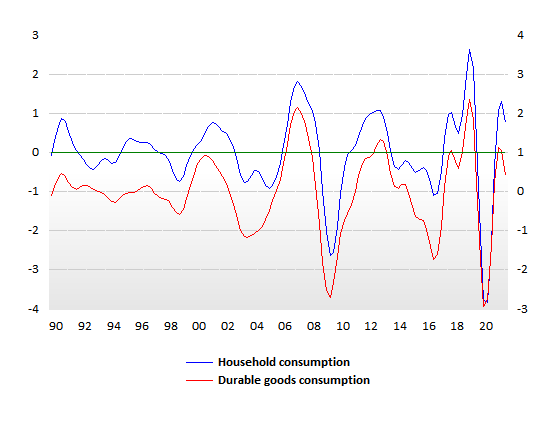
Spending on necessities (non-durable goods and some services) is therefore driven by wage & salary income, with prices and interest rates playing a secondary role. In contrast, discretionary spending (durable and semi-durable goods) tends to be more sensitive to interest rate and price changes. As some durable goods (such as appliances and brown goods) are imported, changes in the value of the rand exchange rate usually pass through to prices. Furthermore, to the extent that purchases are done on credit, spending will be exposed to changes in interest rates. Consumers’ willingness to by, or confidence, is also a key factor in discretionary spending. The result is that durable and semi-durable goods spending tend to fluctuate more than spending on non-durable goods and services. This is evident in Figure 1.
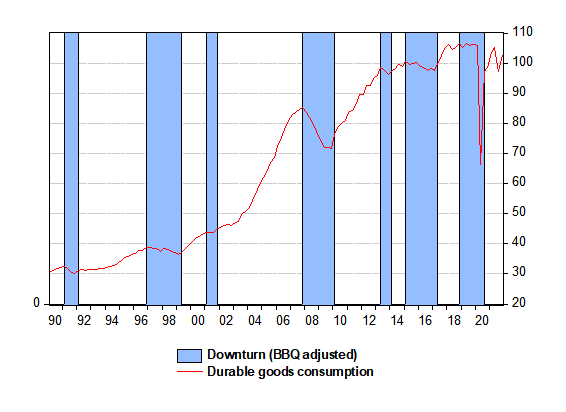
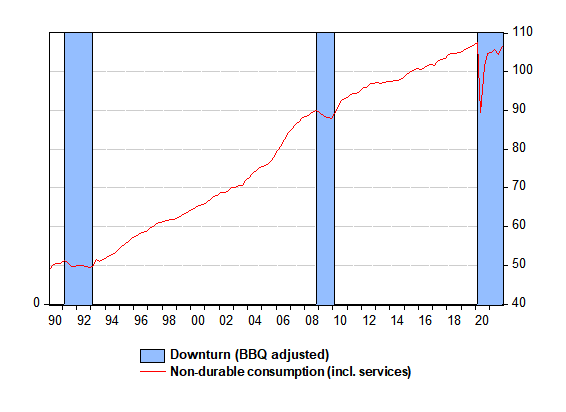
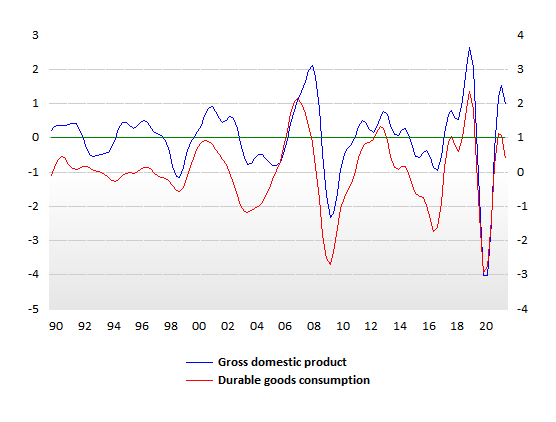
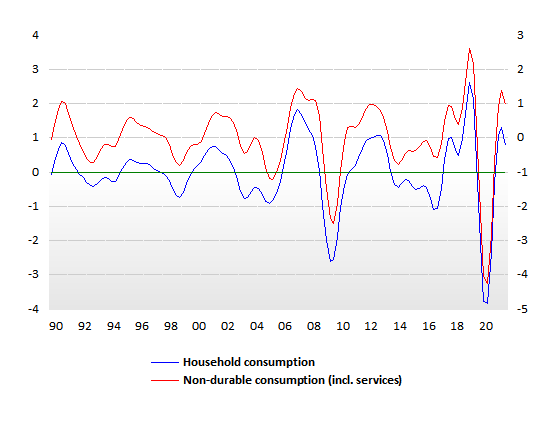
Including spending on services, consumer spending accounts for close to two thirds of GDP (66% in 2021). It is therefore not surprising that we generally find a contemporaneous relationship between changes in consumer spending and the general business cycle – see the charts depicting the cyclical component of consumer spending (Figure 2 and Figure 4, respectively):
- Durable goods consumption, the cyclical component of consumer spending, i.e., the sum-total of spending on durable and semi-durable goods; and
- Non-durable consumption, the non-cyclical component of consumer spending, i.e., the sum-total of consumer spending on non-durable goods and services.
The correlation analysis confirmed a contemporaneous relationship between the main components of consumer spending and the broader business cycle (GDP), as well as with aggregate consumer spending . The analysis was conducted with a quarterly frequency; as the correlation coefficients are high and significant for the first 2-3 quarters, it suggests some lead/lag patterns are present. Refined analysis reveals a leading relationship between durable spending and the business cycle.


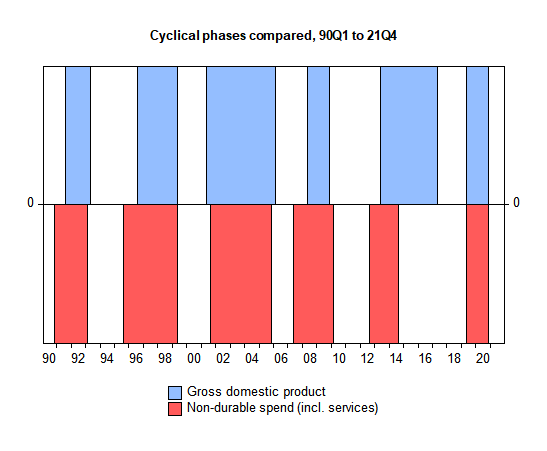
Even though consumer spending on basic necessities like food and energy (non-durable goods) and on services tend to be less cyclical (see Figure 1), the charts shows that when the deviation from trend growth is considered, spending in this category also reveals a cyclical pattern. The close correlation between non-durable spending (including services) and GDP is noteworthy and explained by the fact that it accounts for close to 80% of total consumer spending (charts, right).
An outstanding feature of the consumer cycle, is the close correlation of total consumer spending with the GDP cycle (0.94), as well as the good correlation between the components of consumer spending and GDP (durable goods, 0.84; non-durable spending, 0.93), as well as with total consumer spending (durable goods, 0.93; non-durable spending, 0.97). At a quarterly frequency the lag is zero in all instances. This close correspondence between the phase of the consumer sector cycle and the general business cycle is also depicted in Figure 3 and Figure 5.


Overview of recent developments
National business cycle. The SA economy rebounded strongly during the second half of 2020 from the second quarter COVID-19-induced slump. Before the pandemic impact, the economy was in a classic recession from the third quarter of 2019; however, the downturn commenced at the end of 2013 when the growth momentum dipped below its trend rate. Years of below trend growth and then heavy contraction has left the economy in a parlous state. Business and consumer confidence fell to deep negative territory and the rebound has been less than satisfactory.
In fact, confidence suffered another adverse impact during July 2021 due to deep socio-political unrest in two of SA’s largest provinces, i.e. KZN and Gauteng. While the economy has rebounded, with growth of 4.9% registered during 2021, following the contraction of 6.4% in 2020, high unemployment and sharp price increases in the food and energy sectors are weighing on the SA consumer. The level of GDP is back to levels that prevailed in 2017; however, employment has hardly recovered – the (narrow) unemployment rate has increased from 29.1% in 19Q4 before the pandemic impact to 34.9% during the third quarter of 2021 (including discouraged work seekers, the unemployment rate is 46.6%).
Sectoral business cycle. Consumer spending tended to be resilient, reflected in retail sales growth and business confidence, for a large part of the broader economic downturn from the end of 2013. It is for instance notable that year-on-year growth in real household consumption spending (HCE) never turned negative until the economic lockdown in 20Q2. The analysis shows that HCE tends to lead turning points in the broader business cycle by one quarter and it coincides at troughs. The COVID-19-induced contraction in HCE was less severe compared to the other spending components of GDP. It ended 2020 close to 6.5% below its level in 2019; it recovered by 5.7% in 2021.
An important shift occurred during the period of economic lockdown and continues to linger. As the services sector (e.g. hospitality, restaurants and general tourism) was strictly locked-down, consumers tended to shift income to spending on goods, such as durable and – to a lesser extent – semi-durable goods. The tendency to work from home also provided an injection for the DIY sector, with homeware and hardware stores witnessing strong increases in demand. As the pandemic in general, and economic lockdown in particular began to be phased out, this shift in spending is likely to normalise.
Sub-sector cycle. As noted, the durable (including semi-durable) goods spending cyclical turning points tend to lead GDP at peaks and coincide at troughs. This is similar in the case of non-durable spending. The low level of interest rates and the swift financial market recovery from the pandemic impact have been supportive of higher-income consumer confidence and durable goods spending. Furthermore, this sector also benefited from the shift in spending away from services. On the other hand, the high level of unemployment and income losses in the informal and SMME sectors tend to weigh on lower income consumer confidence and non-durable sales. While financial markets have performed well and high-income consumers did not suffer major adverse impacts on employment, the picture is more dire for lower-income consumers. The adverse impact on employment (e.g. in the hospitality sector) has been substantially more severe and the recovery in employment less robust.
The outcome of these patterns has been that spending on non-durable goods have come under pressure, whereas it benefited initially from the shift in consumer preferences. Durable and semi-durable goods spending is also likely to suffer the impact as spending on services restore again.
Concluding remarks
The retailing – or consumer sector – cycle forms the bedrock of the broader business cycle. It has a contemporaneous relationship with the GDP cycle (with some evidence of leading characteristics) as close to two-thirds of expenditure on GDP is accounted for by consumer spending. The co-movement of non-durable spending (on non-durable goods and services) is even closer due to the fact that it accounts for more than 80% of total consumer spending. This component of consumer spending is less cyclical and is mainly driven by the growth in consumer income and prices.
Discretionary spending (on durable and semi-durable goods) is partly financed from credit, exposing it to factors that impact interest rate movements and consumer confidence. The COVID-19 pandemic caused in major shift in consumer preferences, boosting goods as opposed to services spending. This shift is likely to normalise (at least to some extent) in the months ahead.
Consumer spending is a large GDP component and it also typically has to improve (or slow down) sufficiently before businesses will react by increasing (cut-back on) production capacity. Once business fixed investment spending and hiring develop momentum, this tends to drive the business cycle. Profits and business confidence are key factors. Consumer spending therefore has an initiating role in the business cycle, but is not the driver of it as such.