
Business Cycles 1974-1981 | 1981-1989 | 1989-1996 | 1997-2007 | 2007-2013 | 2013 to date
The overall 1981-1989 business cycle
Officially, SA witnessed two peak-to-peak business cycles over the 1981 to 1989 period. The first recession unfolded when the gold price declined (1981-82) from the dizzying heights achieved during 1980, leaving the SA economy exposed, also having to contend with the impact of a global recession and the Third World debt crisis and the associated capital outflows from risky national capital markets. The country suffered a painful recession during the early 1980s, which, in reality, was ‘interrupted’ by an ‘artificial’ economic recovery between April 1983 and June 1984. A premature easing of monetary policy for political reasons (the so-called ‘Primrose prime’) ‘ended’ the economic downturn[1]; however, the hiking cycle resumed, triggering the second leg of the recession, 1984-86. Viewed this way, the early 1980s economic downturn only troughed in 1986. These years must count as the darkest period, economically speaking, of the old apartheid political order.
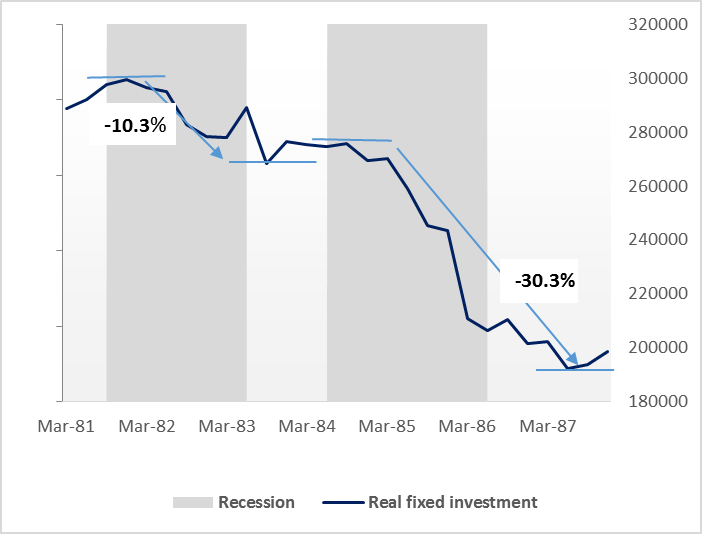
While these two cycles will be discussed separately, attention also focuses on the complete period as one business cycle, i.e. a protracted economic downturn between September 1981 and August 1986 (witness the trajectory of gross domestic fixed investment in the accompanying chart), followed by an economic recovery, which peaked again early-1989.
[1] The prime overdraft interest rate were cut by no less than six percentage points between October 1982 and March 1983 in a development which became known as the ‘Primrose prime’, with the then President of the country, PW Botha, intervening in the decision due to a by-election at the time in the Primrose constituency.
For a narrative of the peak-to-peak 1981-86 business cycle (including the brief 1982-84 cycle) …