Business Cycles 1974-1981 | 1981-1989 | 1989-1996 | 1997-2007 | 2007-2013 | 2013 to date
The 2013-to-date business cycle
The SA economy embarked upon an unusual business cycle exiting from the Great Recession impact in 2009. One of the overriding features of this business cycle was the absence of business confidence and growth in fixed investment for the largest part of the upturn and during the downturn (from end-2013). Business confidence did stage some recovery; however, the best the index could do in the post-GFC era, is to reach a neutral level of 50 index points before it declined again – see chart. Even during the rebound from the unprecedented COVID-19 impact during 20Q2, the index only recovered to 50 index points (21Q2) before it fell back again. The SA economy has not exited this structural condition.

Domestically, this pattern was driven by two deep-cutting influences[1]. Firstly, world-wide economic uncertainty reigning in the wake of the 2008-09 global financial crisis (GFC); the intensity of this uncertainty has been driven to new levels, first, by the COVID-19 impact (2020-21) and, of late (February 2022), the outbreak of war between Russia and the Ukraine, threatening to escalate. Secondly, the SA economic performance being bedevilled by a serious retrogression of governance under the leadership of the former President, Mr. Zuma.
The chart below reveals the poor tendency in fixed investment, inversely related to the extreme levels of general political uncertainty impacting business. The current government under the leadership of Mr. Ramaphosa from 2018, is intent in restoring governance standards. Unfortunately, the record remains checkered as revealed during the COVID-19 pandemic and the Zondo Commission of Inquiry into Corruption in SA[2].
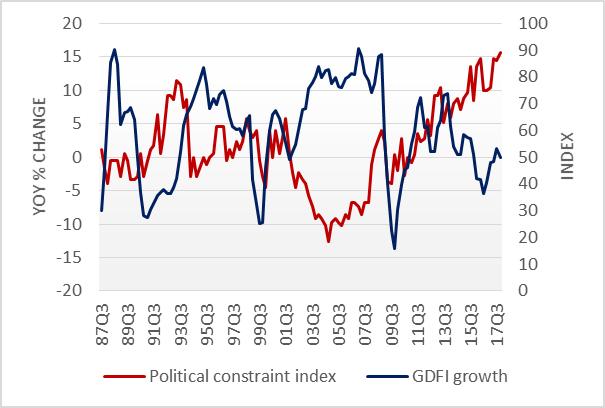
The usual business cycle dynamics changed. The typical robust lift in business confidence and economic growth at a lower turning point in the business cycle went absent. In its place, a ‘wait-and-see’ attitude transpired in the private sector, who preferred expanding overseas. As it turned out, following the rebound from the impact of the GFC and Great Recession (2010-11), the economy hardly expanded and subsequently, hardly slowed down (at least up to the middle of 2019 when it began moving sideways). The economy was trapped in a historic long downturn when the COVID-19 pandemic hit. This state of affairs is best reflected in the trajectory of fixed investment spending from the onset of the 2013-20 economic downturn. The level of fixed investment spending was still more than 20% below that at the peak of the business cycle (November 2013), despite the rebound and economic recovery from the pandemic impact (chart below). The initial stage of the 2013-20 downturn in fixed investment mirrored that of previous economic downturns; however, the hemorrhage was relentless and the post-COVID recovery less than robust. This was the bigger trend. Considering finer growth cycles (read: recurrent periods of above and below-trend real economic growth), it was actually possible to identify an earlier lower turning point following the peak in November 2013.

The SARB officially announced a lower turning point in the economic downturn from the end of 2013 in March 2023. BCA’s analysis identified an aborted upturn shaping from the end-2016/early 2017 up to and including the fourth quarter of 2019. According to the SARB’s comprehensive business cycle-dating methodology, the economy witnessed a short-lived upswing between May 2017 and June 2019. Improved global growth (led by an economic upturn in the USA, 2017-18), international commodity prices (benefiting SA export revenues), as well as accelerated household credit & spending, were the drivers. Thereafter, activity moved largely sideways, until the COVID pandemic hit (20Q2). Economic activity reached rock-bottom in April 2020, which has now been confirmed as another business cycle trough.
The post-COVID economic recovery was shaken again by political unrest (July 2021), sparked by the incarceration of the previous President, Mr. Zuma. Another shock impacted the KZN province a year later (2022Q2) owing to serious flooding (also in the Eastern Cape). Yet, the GDP recovery surpassed the pre-COVID level (calendar 2019) during the first quarter of 2022, earlier than anticipated. The most dramatic characteristic of the post-COVID economic recovery was the serious cost-of-living crisis, inviting 475 basis points repo rate hikes between November 2021 and May 2023. Electricity shortages also accumulated in their intensity and became most worrisome during the first half of 2023.
Consequently, growth has been erratic during the post-COVID economic recovery, and of late, expenditure has come under pressure, knocking confidence. The FNB/BER Consumer Confidence Index fell to -23 points during the first quarter of 2023 and the RMB/BER Business Confidence Index to 27 points during the second quarter of 2023. Yet, a measure of consumer sector resilience (so characteristic of the post-2009 growth pattern) is still detected, albeit in a weakening economy.
Unfortunately, the latest developments in Eurasia, with Russia’s unprovoked war on the Ukraine, have deepened the levels of uncertainty. In the USA, it appears that interest rates have peaked and that the economy may enter a mild recession during the second half of 2023. While inflation is more tenacious in the UK and the Euro Area, monetary policy continues to be tightened in these regions. Post-COVID economic recovery growth in China is also under pressure, while the Japanese economy is showing promising signs of reflation and healthier economic growth.
[1] Cees Bruggemans (6 March 2014), warned in 2014 that SA’s business cycle was being suspended due to the momentous societal changes, combining with the post-2009 global uncertainties.
[2] The Judicial Commission of Inquiry into Allegations of State Capture, Corruption and Fraud in the Public Sector and Organs of State, online: https://www.sastatecapture.org.za/
# The SARB recently determined three new business cycle turning points following the November 2013 peak. The lower turning point was identified as April 2017, followed by an upper turning point in June 2019. The next trough was identified as April 2020 at the time of the COVID pandemic-induced economic lockdowns. BCA prefers to describe the end-2013 to April 2020 economic downturn and subsequent upturn as the 2013-to-date peak-to-peak business cycle. The modest upturn between May 2017 and June 2019 was overshadowed by the relentless fall in fixed investment. The external drivers were not strong enough to stimulate fixed investment spending, the typical driver of the business cycle.
For a narrative of the 2013-to-date peak-to-peak business cycle …