

REAL GDP CONTRACTS AGAIN IN STOP-START POST-COVID RECOVERY, 22Q4
Real GDP growth tapered off from 4.9% in 2021 to 2.0% in 2022. During the post-covid recovery, the quarterly growth pattern proved erratic. Last year was no exception. Impacted by brutal electricity loadshedding, amongst other factors, real GDP contracted again during 22Q4, by 1.3%. This followed a contraction (0.8%), 22Q2 (impacted by heavy flooding in key provinces) and a rebound measuring 1.8% in 22Q3.
The 22Q4 contraction occurred across all three broad sectors, i.e., primary (3.2%), secondary (0.8%) and tertiary (1.2%). Even at the sub-sectoral level, only three industries maintained marginal growth, i.e., transport & communication (0.7%), construction (0.5%) and personal services (0.2%). The quarterly contractions were the heaviest in the agricultural sector (3.3%), mining (3.2%), financial services (2.3%), internal trade (2.1%) and water & electricity (1.9%).
Considering the full year (2022), mining (-7.0%), construction (-3.5%) and water & electricity (-2.6%) suffered the most. The contractions in these sectors constrained recovery growth. On the positive side, the strong growth in transport & communication (8.6%) is notable. Financial services (3.9%), internal trade (3.5%) and personal services (2.7%) also registered robust growth.
The broadest measure of domestic demand, i.e., real gross domestic expenditure (GDE) grew by 3.8% during last year, down from 4.8% in 2021. However, much of this spending was simply imported. Imports jumped by 14.2% during 2022, counteracting the positive boost from exports (7.5%) and resulting in 2.0% real GDP growth. It is also disconcerting that the quarterly momentum in real GDE tapered from 2.0% during the first quarter to -0.1% during the final quarter. This adverse tendency on the demand side of the economy continued during the first quarter of 2023 according the some high-frequency economic indicators.
The growth in real gross domestic fixed investment (1.3%) during 22Q4 should be noted and ties in with the growth in the construction sector. Construction activity has been stimulated by the destruction which occurred in 2021-22 in key provinces owing to looting (mid-2021) and adverse climatic conditions.
Furthermore, it is evident that the massive loadshedding is stimulating a broad-based private sector response (by both households and businesses) in the form of investment in solar and wind energy. Whilst this investment is sector-bound, it does cut across all sectors in society and has a powerful impact. It is of course hoped that the fixed investment activity will become broader based, which typically drives the business cycle.
In sum: the business cycle[1]
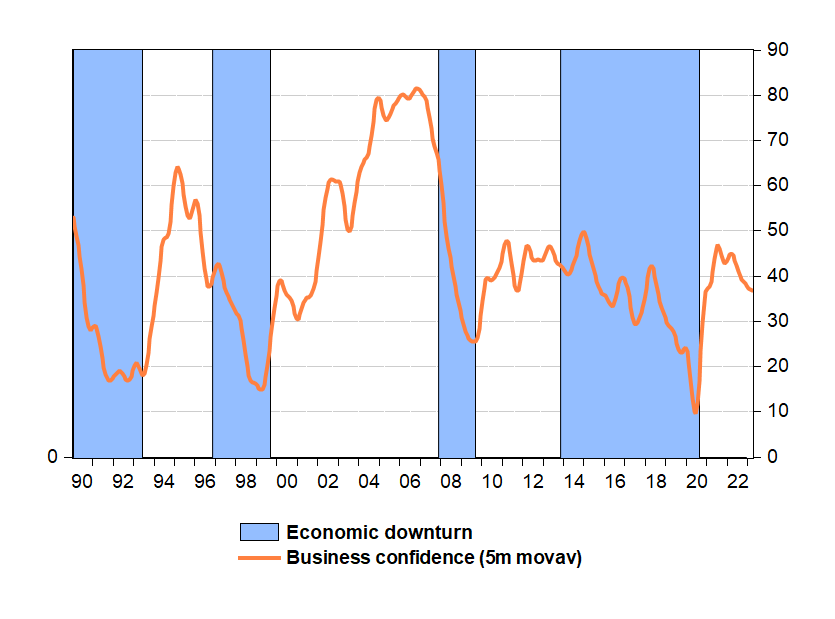
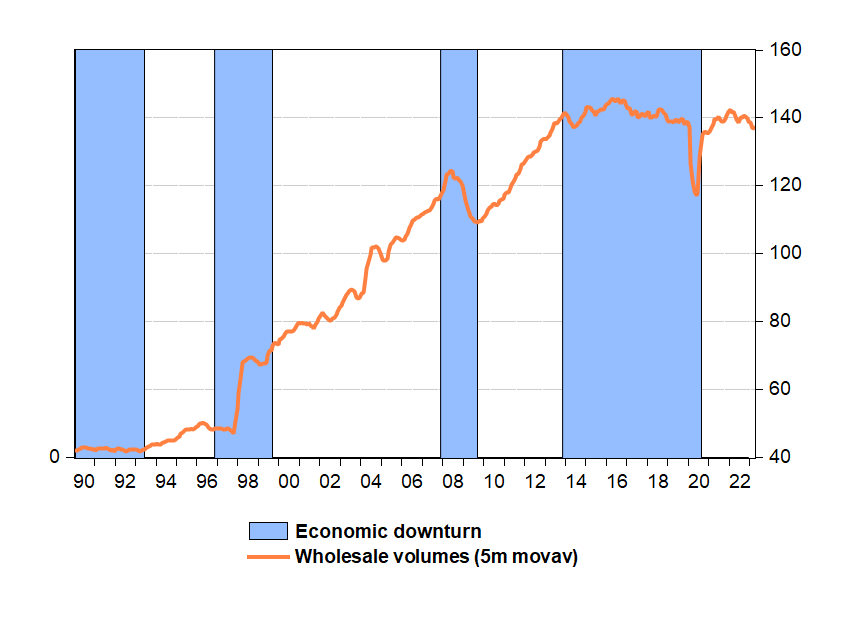
Regarding the latest business cycle indicators, the first quarter is not encouraging. The RMB/BER business confidence index retracted further from 38 to 36 points and consumer confidence plunged from -8 to -23. The deteriorating tendency in the retail- and wholesale sectors noted earlier also continued according to the BER survey results. Sustained spending in these sectors has been an important source of resilience in real economic growth during the pre- and post-COVID periods.
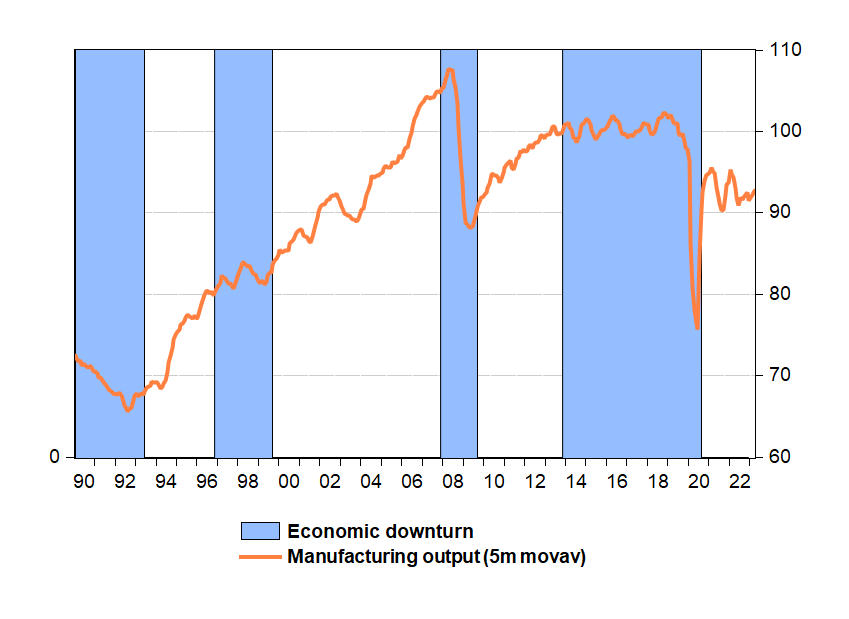
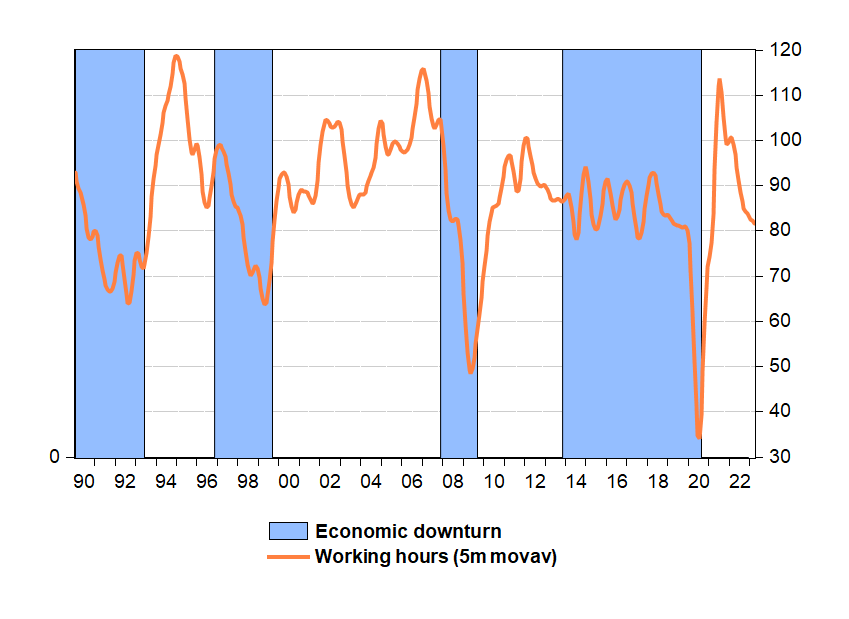
The unhealthy combination of a sharp contraction in manufacturers’ fixed investment intentions, employment and working hours during 23Q1 do not bode well in this context. Short-term interest rates have been increased by 425 basis points from November 2021, which will have its typical delayed adverse impacts on real domestic spending. Inflation inertia, partly driven by food price increases, also remain an adverse factor.
In an economy where the business cycle has largely been obliterated, with stop-start economic activity being driven by socio-political events, climatic factors, and electricity availability, the economic prognosis remains disheartening. The BER’s recession-dating algorithm contains five high frequency economic indicators. While none of these have registered peaks (signalling potential downturns), their annualised growth all entered recessionary territory by mid-2022. GDP recovered during 22Q3 and contracted, 22Q4, while 23Q1 is uncertain.
GLOBAL ECONOMIC GROWTH TRAJECTORY REMAINS UNCERTAIN
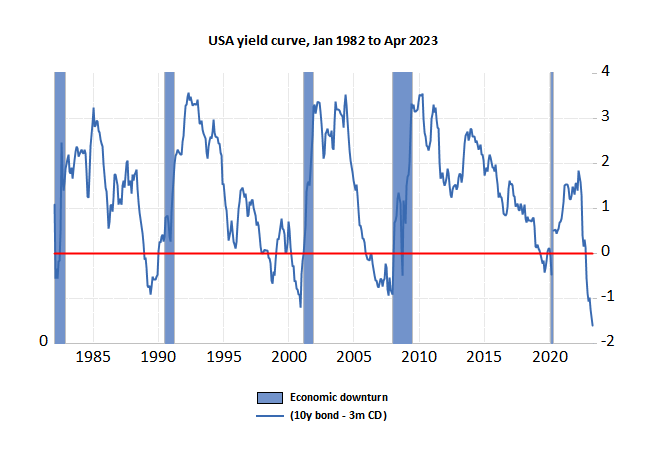
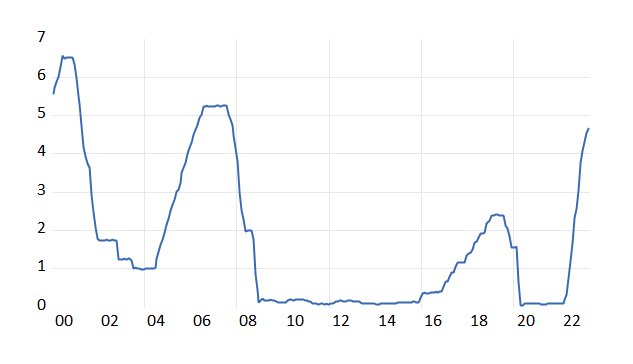
Uncertainty continues to cloud the global economic outlook, partly owing to mixed economic signals. The US labour market appears to still be strong, albeit that the above-trend post-covid recovery annual growth in non-farm employment is tapering off. The US equity market has also developed renewed momentum. Other indicators point to recessionary conditions ahead. The well-documented and historically reliable business cycle indicator, the US yield curve, inverted in November 2022 (Figure 5). Provided its typical lead time, the US economy is about to enter a recession. In fact, considering the two consecutive quarters of contraction in the country’s national income (as opposed to the GDP), a recession is already on the cards. This is also consistent with the level of the purchasing managers’ index, suggesting the sector has entered a period of contraction. In view of the fierce monetary policy tightening in 2022/23 (Figure 6), a slowdown in US economic growth must be in the offing. The labour market and prices follow the business cycle.
Across the Atlantic, the European and UK economies are also slowing down under the impact of higher inflation and interest rates, combined with the global economic slowdown. JP Morgan’s Composite Global Manufacturing PMI has also entered contractionary territory. China and Japan appear to provide some countervailing influence as these countries expand beyond their respective COVID epidemics. This will soften the global economic slowdown underway. Turning to the SA economic outlook, from business cycle research we know that a business cycle does not die of old age. Imbalances begin to develop, which eventually reach breaking point.
The SA economic growth trajectory over the past decade is gradually eroding the economy’s fiscal sustainability. The risk is that such an imbalance has the potential to break the resilience of the economy, causing sharper downward momentum. Such a scenario will be a threat to the social fabric of the country. As it is, the sudden weakening on the demand side of the economy since the end of last year, could cause deeper declines in business and consumer confidence, which will take the economy closer to a sharper downturn. As noted, SA cannot count on global demand as world economic growth is compromised; it is also at risk of financial and other shocks.
[1] BCA hereby wishes to acknowledge that the recession-dating algorithm was designed and developed at the BER, Stellenbosch University.
“When you adopt a cyclical worldview, your outlook will be in the minority whenever the chance of an economic turning point is high”.
Achuthan & Banerji