

SA ECONOMIC RECOVERY CONTINUES, BUT REMAINS INCOMPLETE & FRAGILE, 22Q3
Following the 22Q2 plunge in economic activity related to flood damage in key provinces, as well as intensified electricity supply shortages, the economy rebounded nicely during 22Q3. Real GDP jumped by 1.6% qoq as most sectors registered growth. This momentum is equivalent to that of the first quarter (1.7%) and embodies a welcome sign that the general post-COVID recovery continues. Real GDP measured 1.3% points above its pre-COVID level.
While encouraging, the recovery remains incomplete and fragile. Particularly the secondary sectors (manufacturing, water & electricity, and construction) are well below their pre-crisis levels, i.e., close to 10% points in aggregate. Agriculture (up 28.5%) and the tertiary sector (up 4.3%) account for the bulk of the broad recovery. Within services, retail, wholesale & accommodation (-2.5%) and transport & communication (-1.5%) have also not fully recovered.
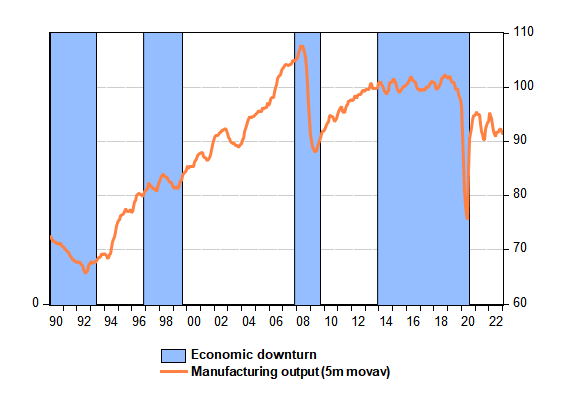
The third quarter jump in GDP was boosted by a 19.2% increase in agriculture, forestry & fishing GDP, also partly explaining the strong jump (4.2%) in exports. The elevated level of key export commodity prices also assisted mining profitability, production, and exports. The return to growth in mining, manufacturing and even construction during the third quarter provides a platform for the general economic recovery continuing. Unfortunately, as noted, the recovery on the demand side of the economy remains tenuous. Real domestic spending is only 0.7% above pre-crisis levels and this include a huge jump in inventory investment during the third quarter. Gross domestic fixed investment improved only modestly and remains more than 10% below pre-crisis levels during the third quarter.
Real household consumption contracted by 0.3% in the face of the inflation spike (including sharp increases in food and energy prices), increase in interest rates and poor consumer confidence as the broader recovery in employment also lags. Furthermore, the tenuous economic recovery faces serious headwinds. These headwinds include, firstly, the ongoing damaging electricity shortages; secondly, the slowdown of the global economy in the wake of tighter monetary policies, and similar forces unleashed locally given the three hundred basis points increase in interest rates since November 2021. General political uncertainty also reigns amid the governing party’s election of its leaders in December. It is clear, particularly, given the developments on the demand side of the economy, that the post-covid economic recovery is taking strain.
In sum: the business cycle[1]
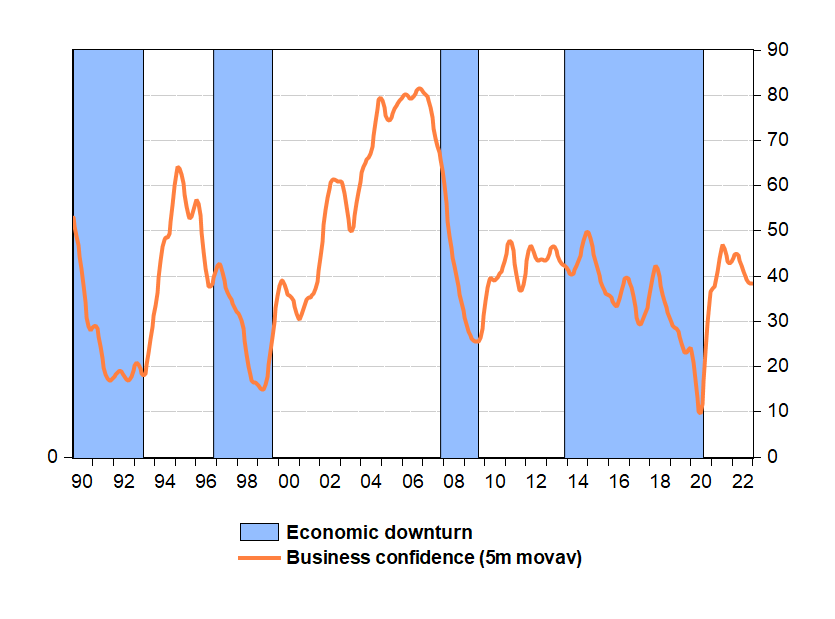
The RMB/BER Business Confidence Index receded another index point during the final quarter of the year. On the one hand, this decline was surprisingly small given all the adverse developments during the second half of the year, with stage 4 (and above) loadshedding becoming the order of the day. As such, it also reflects resilience in parts of the economy. On the other hand, it shows that more than six out of ten business executives remain unsatisfied with general business conditions.
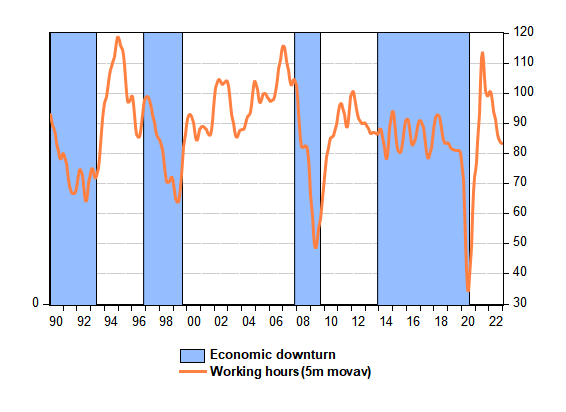
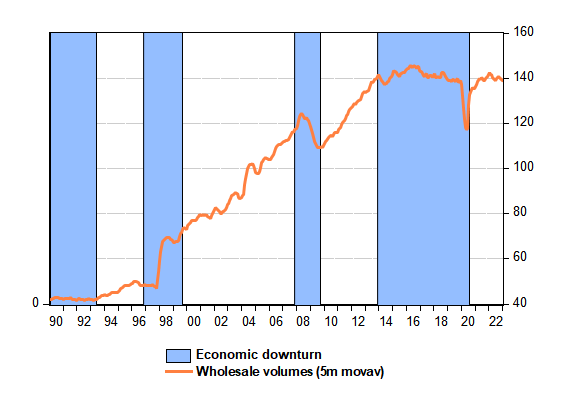
Apart from autonomous infrastructure-related fixed investment expenditure (e.g., in the renewable energy field), the prospect of broad-based capital spending on the back of satisfactory general business (read: demand) conditions remains somewhat of a chimera. Until such time, the trajectory of the economic cycle is likely to remain flattish, with characteristic resilience preventing contraction. The BER’s recession-dating algorithm reveals tentative signs of an upper turning point in the growth cycle since the post-covid economic recovery commenced in 2020.
A worrying sign as far as the general business cycle is concerned, is the indication that the erstwhile resilient consumer sector is beginning to take strain. Retail and wholesaling business confidence dipped well-below the neutral level of fifty index points during the fourth quarter. Other high-frequency economic data also indicates as much. Lagging employment creation, declining real wages and consumer uncertainty are all taking a toll on consumer spending.
Monetary policy is likely to respond to these fragile conditions, particularly as we witness lower inflation over the short term. The latter is not a foregone conclusion as cost-push factors (e.g., a weaker currency, energy price shocks, etc.) have the potential to derail the applecart. In all, a highly uncertain economic outlook.
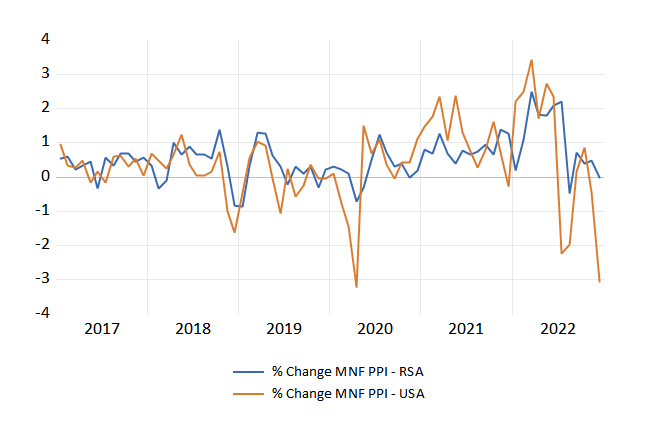
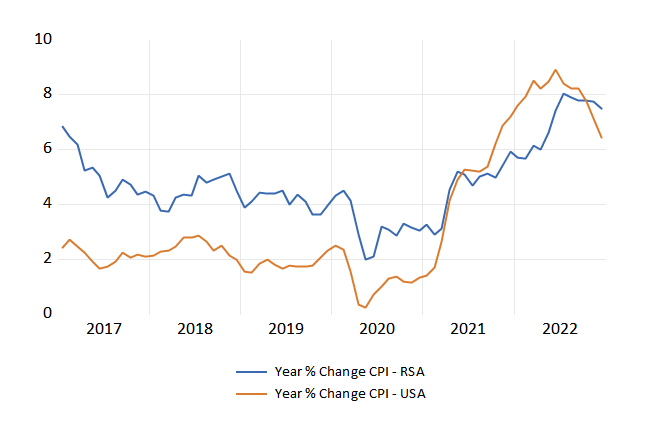
Consumer inflation lags the decline in producer inflation
By the end of 2022, the signs were clear that the inflation spike of 2021-22 was peaking – the monthly average change in PPI inflation in the USA measured -0.73% (after peaking above +3% early in 2022). Even the year-on-year CPI inflation rate in the USA peaked above 8% around the middle of the year, with the average monthly change during the second half of the year receding to +0.2% (down from above 1.5% in June/July 2022). While consumer inflation is slower to recede, PPI is leading the way, pointing to lower inflation in the months ahead.
The disappearing cost-raising effects tied to the supply-chain bottlenecks in the wake of the COVID pandemic are driving the slowdown in producer inflation. International crude oil prices have also receded from the war-induced increases (peaking in March last year). CPI inflation is likely to decline, but one should expect some inertia in this process. This will influence the trajectory of the interest rate cycle.
This is mainly owing to the monetary sources of the inflation spike, wage demands in a strong (US) labour market and the role of inflation expectations, adding to a wage-price dynamic. This, in turn, keeps central banks on their back feet. Central banks are forward-looking and as inflation is expected to recede, one expects the current hiking cycle to end. However, central banks, also need to ascertain whether inflation expectations have not been dislodged. If they have been, it may lead to a more permanent lift in inflation. This is the current threat.
It is expected that in softer demand conditions, consumer inflation will continue to recede, if only slowly. Therefore, the interest rate hiking cycle is close to an end. Global economic growth prospects are being scaled down, amidst geo-political uncertainties. Should the US economy enter a recession, it is expected to be short-lived. Countervailing growth in China should also prevent a global recession from taking hold. The war in Ukraine, as well as geo-political shifts, cloud the economic outlook, escalating the levels of uncertainty.
[1] BCA hereby wishes to acknowledge that the recession-dating algorithm was designed and developed at the BER, Stellenbosch University.
“When you adopt a cyclical worldview, your outlook will be in the minority whenever the chance of an economic turning point is high”
Achuthan & Banerji