

SA ECONOMY SCRAPES A TECHNICAL RECESSION, 23Q1
Following the contraction in real GDP during the final quarter of 2022, the economy scraped a technical recession during the first quarter, expanding by a modest 0.4%. Encouragingly, most sectors returned to growth during the first quarter. Overall growth would have been stronger was it not for a sharp contraction in agricultural GDP (12.3%). Water & electricity GDP contracted by 1.0%; all the other sectors expanded. The recoveries in mining (0.9%) and manufacturing (1.5%) are welcome given the disproportional impact of electricity outages on these sectors. All the services subsectors also posted growth, 0.7% in aggregate. The evidence points to firms adjusting to the impact of loadshedding. Business volumes are better than expected in view of the prevailing electricity shortages and general business conditions.
The economy’s momentum has weakened though. This is, inter alia, reflected in a sharp weakening of consumer and retailing business confidence during the first quarter. Certain categories of retail spending (e.g., durable goods) and spending on consumer services have come under pressure. The weakness on the demand side of the economy is a noticeable deviation from the post-2009 resilience in the consumer sector. Considering the available evidence during the first half of the year, it would appear as if a measure of resilience is persisting, despite the weakening momentum.
It remains evident that investment in renewable energy is at the bottom of much economic activity. For one, this is stimulating construction activity. It must be emphasized that re-engineering a business’ energy supply does not necessarily amount to an expansion of production capacity. Some businesses may regard such spending as merely a cost item, and not capital expenditure. Nonetheless, as noted in the previous report, investment in this sector cuts across society and may be a catalyst for a broader fixed investment revival.

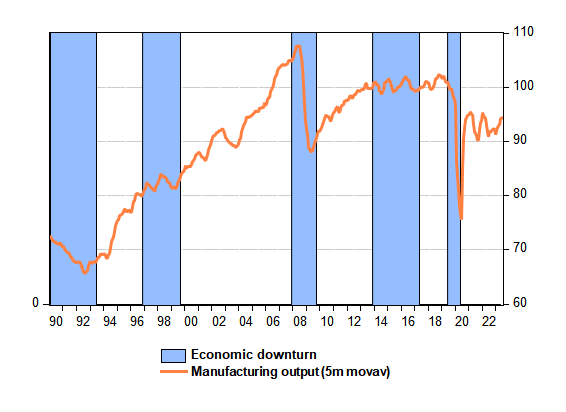
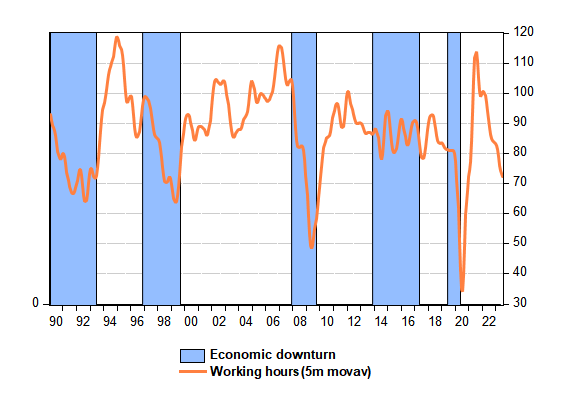
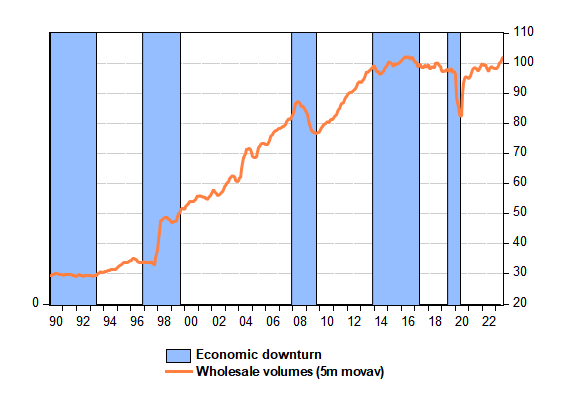
The business cycle[1]
Unfortunately, the news on this front is not encouraging. Private fixed investment hardly expanded during the first quarter of 2023. The RMB/BER Business Confidence Index tumbled by nine index points during the second quarter. A substantial part of this decline in confidence may be linked to reduced demand and profitability in a range of sectors, as well as the impact of loadshedding and the unfavourable socio-political (and geo-political) climates. BER survey respondents’ 12-month general business expectations fell to a historic low. Manufacturers’ fixed investment intentions deteriorated and factory working hours continue to be cut back. Four of the five components of the BER’s recession-dating algorithm entered recessionary territory by the middle of last year. As noted, a measure of resilience is detected in retail and wholesale volumes, as well as business services.
While the loadshedding schedule eased in June, the Western Cape was battered by flooding and the BER’s survey results point to a potentially weaker GDP outcome during the second quarter compared to the first. The threat of serious loadshedding during the winter months of July/August also remains. The global economy is slowing down, (potentially) led by a mild recession in the USA.
Domestically, the post-COVID expansion (commencing in May 2020) has plateaued, with the forecast risks being mostly on the downside. First quarter real GDP was measured on the same level of that a year ago. Economic growth for 2023 may not be much better, if not worse. The SARB recently identified three business cycle turning points after the previous peak (Nov’13). Apr’17 has now been identified as the trough of the subsequent downturn, with the economy witnessing a short-lived upturn between May’17 and Jun’19.
Improved global growth, commodity prices, household credit & spending were the drivers. Thereafter, activity moved sideways, until the COVID pandemic hit in 20Q2, which has now been confirmed as another business cycle trough. The post-COVID economic recovery was hit by intermittent shocks (flooding, socio- political unrest, & electricity shortages), and a cost-of-living crisis (inviting 475 bps repo rate hikes). Economic growth has been erratic. Spending has also come under pressure, knocking confidence. Yet, a measure of resilience is detected.
Pivotal – US interest rates may have peaked …
The Fed’s interest rate announcement on the 15th of June sparked divergent interpretation. Some analysts, emphasising the underlying growth (labour market) momentum of the economy and hence longer-term inflationary pressure (inter alia reflected in the level of core CPI), question the logic – why project further hikes (Fed’s dot plot) and not use the current opportunity to hike? These commentators describe the FOMC statement as “hawkish”. Other analysts, more aware of the slowdown of the economy (and labour market) underway (as is this author) interpret the Statement as a tactical example of careful Open Mouth Operations – a pause, combined with a hawkish statement intent on quelling undue market frenzy. These analysts also typically see rapid disinflation over the short term. BCA is firmly in the latter camp. We have been convinced about the ‘once-off’ COVID-induced supply-chain shocks and mismatches underlying the recent (global) inflation spike. The spike was also prolonged by the lagging epidemics in the East, as well as being exacerbated and prolonged by the Russian-Ukraine war.
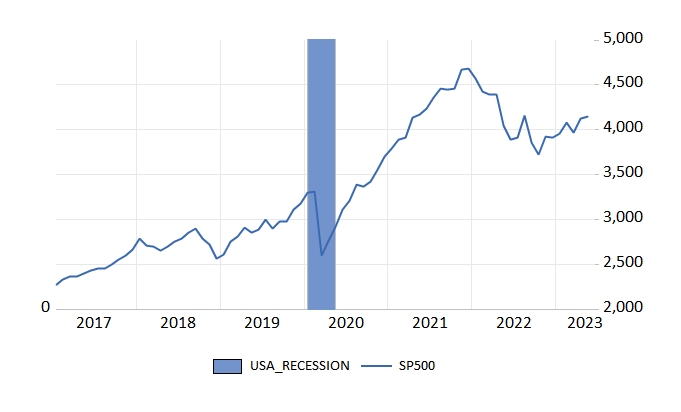
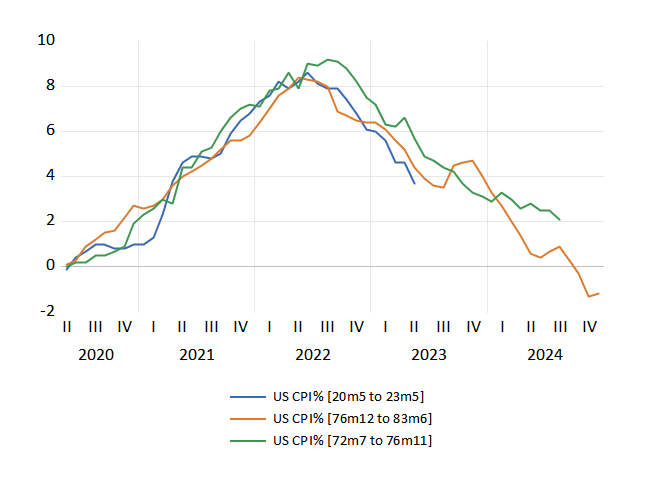
The Fed commenced late with tightening monetary policy (March 2022), then proceeded aggressively. Whether induced by supply-demand mismatches and shifts, or monetary stimulus, the Fed had to raise interest rates, ensuring the credibility of the monetary policy framework and contain inflation expectations. The trajectory of inflation expectations, both over a 12-month and 5-year horizon, attest to the fact that they did not become dislodged.
Furthermore, BCA remains convinced that owing to the disproportionate weight that supply bottlenecks (and war) carried as sources of the inflation spike, it is to be expected that CPI inflation will decelerate noticeably over the coming months. Core inflation has been sticky downwards. An inflation spike is typically asymmetrical – the disinflation phase is a slower process. The Fed is, in addition, containing the growth in money supply by Quantitative Trimming (QT), attending to the monetary sources of the inflation spike.
Finally, as noted in the previous issue (1st Quarter 2023), the US economy is about to witness a mild recession, which will further deal with the remaining demand-side inflationary pressures.
[1] BCA hereby wishes to acknowledge that the recession-dating algorithm was designed and developed at the BER, Stellenbosch University.