
SA ECONOMY REMAINS ON THE RECOVERY ROAD, 21Q4
The SA economy remained on the recovery road in the fourth quarter of 2021, with real GDP expanding by 1.2% (quarter-on-quarter). In year-on-year terms, real GDP was up 1.8%. However, compared to pre-covid levels (19Q4), real GDP is down 1.5%. The 21Q1 level of GDP is comparable with the levels that prevailed in 2017. The recovery from the third quarter contraction (revised down to 1.7%), related to the socio-political unrest in key provinces, was also incomplete.
Considering the supply side of the economy, recovery growth was led by a sharp rebound in the agricultural sector, which was, amongst other, also impacted by the riots in July. Real agricultural valued-added grew by 12%. Real agricultural GDP ended last year close to 16% above pre-covid levels. Other strong positive performances were delivered by the retail, wholesale & hospitality sector (up 2.9%); manufacturing (2.8%) and personal services (2.7%). The internal trade and manufacturing sectors’ real GDP levels are still 5-6% below pre-covid levels; that of personal services is close to 6% above the level in 19Q4. Transport & communication also delivered reasonable growth (2.2%) and is up 5.7% year-on-year.
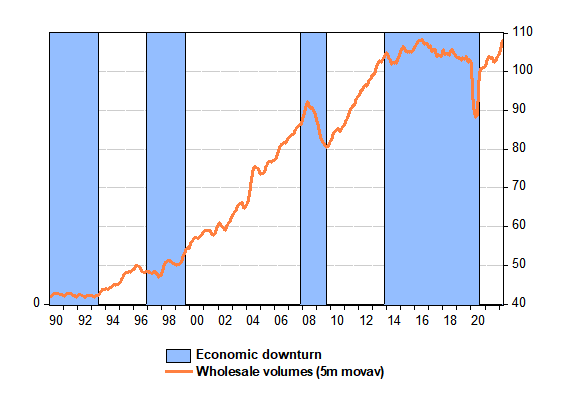
The sectors, which subtracted from quarterly growth during the fourth quarter of 2021, include water & electricity (-3.4%); mining (-3.1%), construction (-2.2%) and financial services (-0.8%); general government real value added contracted marginally (-0.4); however has remained relatively stable before and during the pandemic impact. This is also reflected in government consumption, excluding the COVID-19 related spending, which spiked in the middle quarters of 2020. Real government consumption remained flat during 21Q4 and was up only 0.7% from pre-covid levels (19Q4). On the demand-side of the economy, spending was adversely affected by the socio-political unrest in July 2021, contracting quite sharply. These components of GDP recovered during the fourth quarter, with both exports (up 8.5%) and imports (8.9%) being quite strong.
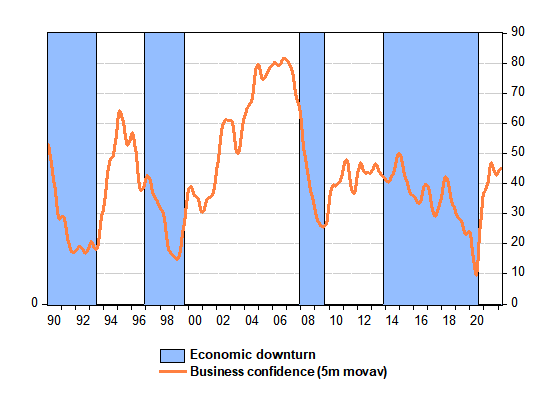
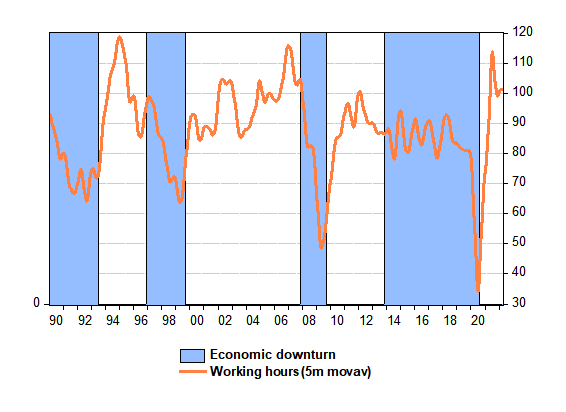
Net exports remained slightly negative, subtracting from the recovery growth in household consumption (2.8%) and fixed investment (1.9%). The positive growth in real fixed investment spending was welcome; however, the level remains close to 10% lower compared to two years ago. The poor level of fixed investment spending is tied to the fact that the economy continues to operate below full production capacity. It is also impacted by uncertainty and – on the infrastructure side – delivery failure. This also explains why the unemployment rate continues to tick-up as employment has hardly recovered from the COVID-19 lockdown shock in 2020. Business confidence remained stable during the fourth quarter of 2021 and increased modestly by three index points to 46 during the first quarter of 2022. The BER survey results indicated that general economic activity picked up during the first quarter of the year, also signalled by January/February economic indicators. All indications, therefore are that the SA economy remains on its post-covid recovery road.
The business cycle
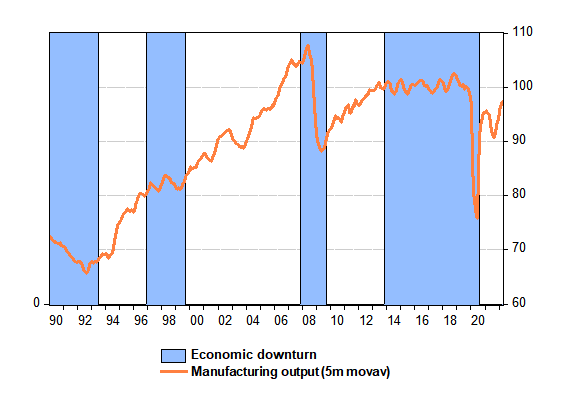
While the SARB has not announced a lower turning point in the business cycle downturn from the end of 2013, three out of the five components of the BER’s recession algorithm[1] signal such a lower turning point (17Q1). We await more data to confirm this. An interesting development is that with the latest and revised data, the BER recession-dating algorithm signaled a proper upper turning point in the fourth quarter of 2019, with all five components of it peaking. This hints again to a possible brief upswing phase of the business cycle over the 17Q1 to 19Q4 period. However, it is not clear that the SARB will identify this upswing phase. Should the Bank regard this period of above-trend growth as spurious, then 20Q3 presents itself as the lower turning point of the economic downturn that commenced in December 2013.
The post-covid economic recovery continued in the first quarter of 2022, but will be adversely impacted by Russia’s offensive in the Ukraine. This unprovoked war carries a heavy escalation risk. SA’s balance of payments benefit from key commodity price increases, providing impetus to the growth momentum.
On the negative side, the economy is exposed to the spike in energy and food prices and probable recessions unfolding in key trading partner regions (e.g. the EU). War and geo-political uncertainty have superseded the disruptions caused by the COVID-19 pandemic. These forces tend to have a formative influence on the business cycle. Globally, interest rates are on the rise due to the spike in inflation. Interest rate hikes commenced towards the end of last year in the emerging market countries, with resident central banks intent on preserving financial stability. The chart shows the rise in US 10-year bond yields approaching 200 basis points, which is low in a historical perspective. Accounting for inflation, real yields are currently at a historical low. (This says something about the growth outlook – see below).
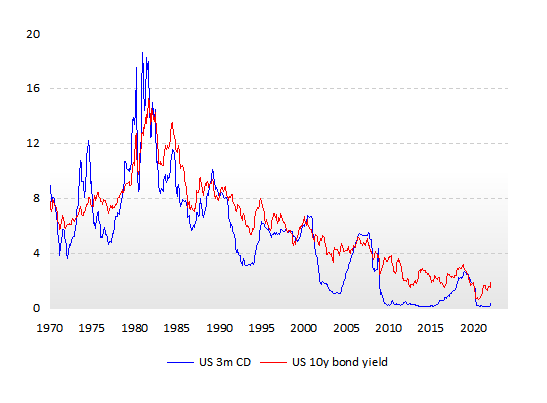
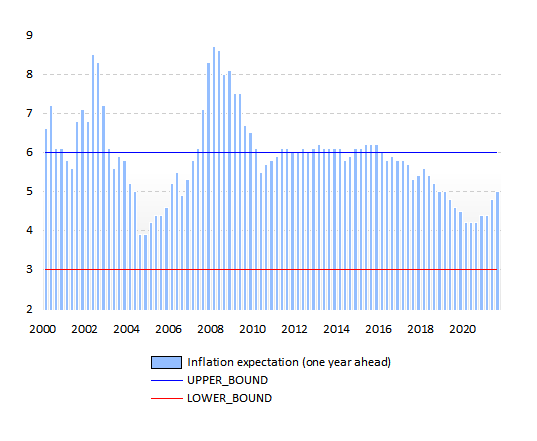
The US began tapering its asset-purchase programme (QE) and the Fed is about to implement its first interest rate hike. Despite, inflation spiking higher than expected, BCA continues to argue that it should recede towards the end of 2022. The critical variable to monitor regarding monetary policy will be inflation expectations. In the US, the 5-year breakeven inflation rate has risen to 3.5% (i.e. a measure of inflation expectations), which is well above the 2% upper bound of the informal inflation target. In SA, CPI-inflation expectations (one year ahead) have increased by 50 basis points to 5% – see chart. While this will be a worry-sign for the respective central banks, it is too early to say that inflation expectations have become dislodged.
The outbreak of war is a stagflationary shock to the world via higher energy and food prices[2]. Firstly, it adds to the COVID-19-induced spike in general inflation. Secondly, the GDP contractions in the affected countries also subtract from global growth. This counters the inflation pressure, but damages growth and employment creation.
The Fed and the SARB focus on core inflation for monetary policy purposes, which excludes the impact of higher food and energy prices. Paul Krugman argues the impact of the war on the world economy will be bad, but not catastrophic – see Krugman, P (8 March 2022): How the Putin shock might affect the world economy, [online] https://messaging-custom-newsletters.nytimes.com/template/ US short-term interest rate expectations remained unchanged after Russia’s attack on the Ukraine commenced. Current expectations see the Feds Fund rate around 300 basis points by mid-2023. The reality may turn out to be less dramatic.
Interest rate hikes will be capped when inflation begin receding (most likely undershooting expectations towards the end of 2022) and the global growth momentum suffers as a direct outcome from the war.
Any short-term capital outflows from SA related to the interest rate differential may be countered by net non-resident purchases of mining stocks, benefiting from the increase in commodity prices. The rand has been remarkably strong in recent weeks and may continue to benefit over the near term.
Medium-term, the higher interest rates spell lower commodity prices, which has been and is in prospect beyond the COVID-19 and war-induced spikes in key prices. Given, a current account surplus on the SA balance of payments for calendar 2021, combined with the foregoing analysis of commodity price movements, the SA financial markets (and by extension, the real economy) may be sheltered over the near term in the current upcycle in interest rates.
This will afford the economic recovery to continue and crossing the threshold to proper expansion. Nonetheless, BCA’s view of constrained medium-term growth remains – the economic upturn is likely to be a hard slog rather than coming in any way close to shooting the lights out. High unemployment, political realignment, structural constraints to growth only lifting incrementally and an unsupportive world economy motivate such a business cycle outlook.
[1] BCA hereby wishes to acknowledge that the recession-dating algorithm was designed and developed at the BER, Stellenbosch University.
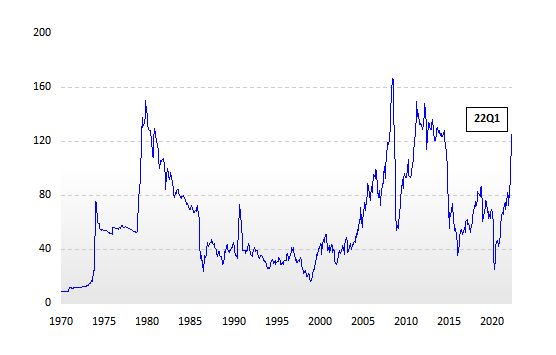
[2] Before the Russian attack on the Ukraine, these two countries produced more than a quarter of the world’s wheat; both countries (and Belarus) also produce the bulk of key ingredients in fertilizer (e.g. potassium). Food shortages in key parts of the world are a stark reality in the coming months. Oil prices (in constant price terms) have rocketed to levels close to the peak at the end of 1979 in the wake of the Iranian Revolution. This may be an overreaction as Russia only produces 11% of the world’s oil, whilst the Middle East produced more than a third of the world’s oil supply in the late 1970s.
“When you adopt a cyclical worldview, your outlook will be in the minority whenever the chance of an economic turning point is high”
Achuthan & Banerji