
There is something scary about the latest inflation numbers around the world. US producer inflation reached 17.9% in March; that in Germany has shot up to 30%; locally, PPI inflation accelerated above expectation to 11.9%. Consumer inflation has followed, particularly in the goods department. US CPI inflation has accelerated to 8.6% (from 2.3% pre-covid); locally, CPI inflation has hit the upper bound of the 3-6% inflation target (from 4.1% pre-covid).
The scary part is that the month-on-month momentum has been building – in the US this momentum increased from 0.05% in 2019 on average (PPI; pre-covid) and 0.02% in 2020 to 1.2% in 2021 to 2.2% in January 2022, 2.6% in February and 3.3% in March. It has also spread to the consumer sector and has gone beyond food & energy prices. Core measures of inflation in the US has risen to 6.5% in March, with the monthly momentum building from a stable 0.2% pre-covid, doubling in 2021 and rising to above 0.7% in 2022. Locally, the monthly momentum has accelerated from around 0.3% pre-covid to 0.5% in 2021 on average and currently stands at 0.8%; year-on-year core CPI inflation measured 3.8% in March.

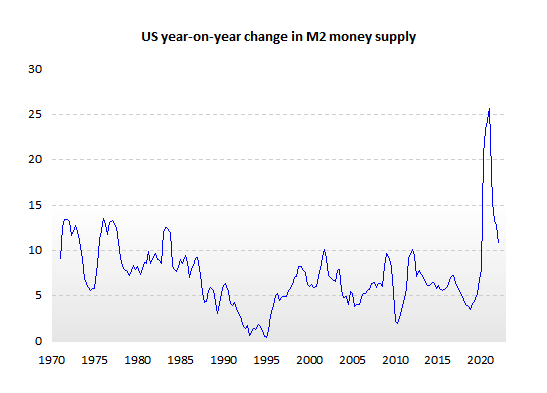
This inflation momentum is shocking and exceeds all expectations. While one gets the sense that it may be close to a peak, the question is how central banks will respond? There is certainly an element of overheating demand in the USA. The growth in the M2 money supply hit a peak of 27% year-on-year in February 2021. This came on the back of the explosive increase in the Fed’s balance sheet following its massive bond-purchase programme (estimated at around a cumulative $4.5 trillion). The increase in the money supply has boosted expenditures in the economy, whilst the production side has been adversely impacted by the covid-induced lockdown measures across the globally disrupted supply chains. Currently, China’s zero-tolerance COVID policy is prolonging the supply chain disruptions and the war in the Ukraine and associated geopolitical tensions have added insult to injury. Sector-specific price hikes (oil & gas, fertiliser and various food stuffs) have been unsettling. Combined with the swing in the consumer sector to the purchasing of goods, this inflation tsunami was sure to happen. Furthermore, as wages rise and input costs increase, services inflation also increases. This explains the increase in core measures of inflation and the various central bank responses commencing with tighter monetary policies.
In summary, the annualised momentum in CPI inflation between April 2020 and March 2022 amounts to 6% in the US and 4.8% in SA. The corresponding PPI numbers are, 14.8% and 8.9% respectively. Similar to not being able to fathom the shock and awe of the global economy coming to a standstill in 2020, it is difficult absorbing the current inflation shock. The monthly momentum indicators show that inflation has not peaked – see the chart. With this background, what is the inflation and interest rate outlook?
The sequence of the inflation tsunami
It is important to sequence the inflation spike between 2020 and 2022. Evaluating the monthly momentum in PPI and CPI inflation respectively (see chart), it is easy to observe there have been three mini-spikes and sources: first, the re-opening from COVID-19-induced economic lockdowns (mid-2020), including the shifts in consumer spending and supply-side bottlenecks related to (intermittent) supply chain disruptions. This, combined with energy price increases, shaped the ‘first wave’. The ‘second wave’ hit during the first half of 2021, after crude oil prices more than doubled from their lows in April 2020 at the apex of economic lockdown, and re-doubling thereafter (from $40 to $80).

Arguably, elements of overheating demand in the US as the labour market and consumer sector recovered, aided by massive macroeconomic stimulus, also entered the fray in 2021. The third spike arrived during the early months of 2022 with the unprovoked Russian invasion of the Ukraine. Crude oil prices rose again (from $80 to above $120), now exacerbated by gas price increases as well as food and fertilizer price hikes.
All along, some passthrough occurred to the core inflation categories, reflected in the increase in core CPI inflation. Producer inflation led and is leading the charge currently in the ‘third wave’. Clearly, the increase in consumer inflation (as well as core CPI) have further to run before it will peak. Food shortages caused by the war is a dangerous exogenous threat to the global food price and inflation outlooks.
While the increase in inflation is shocking, it remains fair to conclude that for now it still complies with the definition of a once-off (albeit a somewhat drawn-out) spike. Inflation expectations have increased, but have not been dislodged. The higher inflation has not become entrenched. Central banks are on guard and have already responded – the Fed with a 25 basis points hike in March (the first in more than three years), the SARB with 75 basis points, commencing in November 2021.
The inflation outlook and realistic monetary policy expectations[1]
It was recently (23 October 2021) argued on these pages, that the inflation spike could be temporary. The inflation scare has actually intensified since then and received a further ominous boost owing to the war in the Ukraine. The latter mainly added to the inflation spike via additional increases in energy, food and fertiliser prices. Contrary to expectation, an element of overheating demand conditions in the US specifically also transpired. In short, the inflation scare has indeed become more ominous. The big question remains whether these are signs of permanency? Will inflation expectations become dislodged, with the associated wage-price and (for developing countries) exchange rate-price spirals? Should this indeed be the medium-term prospect, monetary policies will be tightened more fiercely, with the resultant growth and unemployment repercussions being worse until inflation is brought back into fold. It remains critical to provide additional perspective regarding the inflation and interest rate outlook.
The first point to make, is that the inflation spike is a global one. The initial phase was driven by the COVID-19-induced distortionary effects (as noted) and is currently being exacerbated by repercussions of war and geopolitical tensions. The pandemic has been entering its expiry phase. The supply chain bottlenecks and associated price hikes should subside with it. The future of the war and its associated economic distortions are harder to predict. To the extent that the inflation spikes in national economies are part of the global forces, national central banks may rest assured that the acceleration of inflation in their respective economies is not a direct result from overheating demand conditions. Their second-round effects, however, need to be attended to.
Secondly, the global economic growth outlook remains constrained. US real GDP contracted in 22Q1; China’s growth came in below target (at 4.8%), but is expected to cool down significantly due to COVID and the government’s strict zero-tolerance approach, as well as the global impact of the war. The mega trends noted previously remain part-and-parcel of the global economic outlook – high debt levels; low productivity growth; adverse demographics; increasing inequality and its associated distortions; climate change and the increased frequency of climatic crises, etc.. The war has a stagflationary impact on the world economy – it boosts inflation, whilst at the same time, thwarting growth prospects – consumer confidence has been one of the first casualties. High inflation also reduces real disposable incomes. In the US, personal consumption still remained strong during the first quarter of the year, but is likely to cool down substantially.
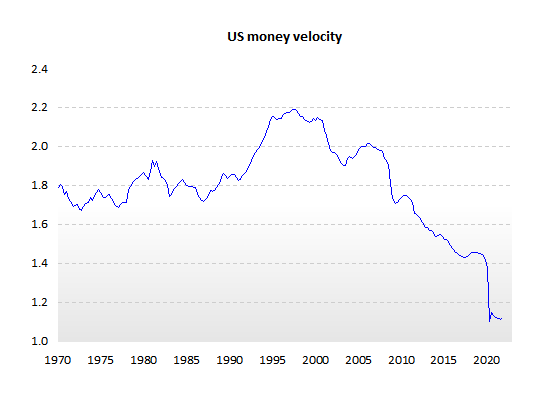
Thirdly, regarding the monetary sources of inflation, it should be noted that the substantial acceleration in US money supply growth has added to overheating pressures, but is not being sustained (chart above, left). Part of the reason is to be found in the transmission of the QE stimulus and part is owning to the tightening of US monetary policy (including the systematic withdrawal – and eventual reversal – of QE support). Finally, while the money supply has exploded, the velocity of the money supply has plunged (chart above, right). This counters the demand-driven sources of inflation. Furthermore, Paul Krugman argues that the wage-price spiral is not in existence anymore owing to the reduced role of labour unions in the US economy [How a recession might — and might not — happen; accessed online, 22 April 2022 https://www.nytimes.com]. More importantly, the higher levels of inflation have not as yet become entrenched – medium-term inflation expectations continue seeing modest inflation ahead (Figure 1).
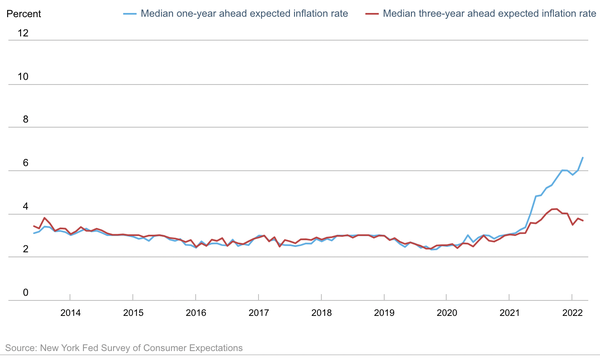
The US (and the world) is living an inflation shock of extreme and cumulative proportions. It is likely to pass when the current overheating elements disappear (owing to monetary squeeze and economic growth constraints), the pandemic has run its course and the war has been dealt with. Of these three prospects, that of the war are the most uncertain. Despite the higher intensity of the inflation scare (and shock), we remain confident that the medium-term scenario is one of a return to targeted inflation. Neither the US economy, nor outside of the US, permanent high inflation similar to the 1970s and early 1980s is currently evident. Near-term inflation expectations are high, but medium-term inflation expectations remain anchored – of late, trending lower in the US. During the 1970s and early 1980s, high inflation and expectations became entrenched, being fuelled by irresponsible macro-economic policies (read: the monetisation of fiscal deficits). This time is different (see blog post, 23 October 2021). The goal posts have shifted though and US CPI inflation is now only projected to breach the targeted 2% level towards the end of 2023.
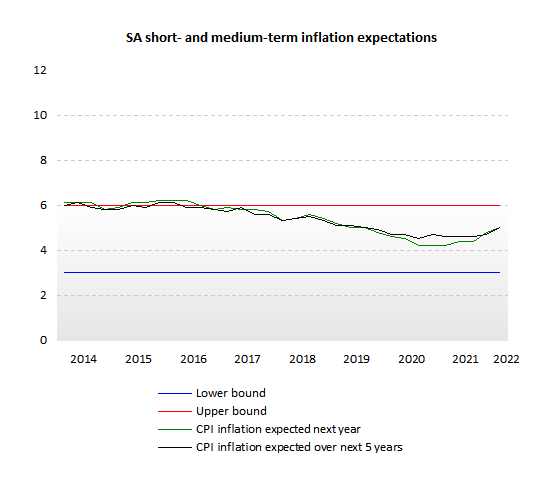
The US is currently suffering higher inflation compared to SA and US inflation expectations have been shaken more compared to SA – see the charts. SA inflation expectations, both one and five years ahead, are poised at 5%, which is well within the 3-6% inflation target band, albeit above the mid-level of this band, which has become the SARB’s targeted rate of inflation, i.e., 4.5%. It can safely be said that SA’s inflation expectations remain anchored. This will be an important variable in the equation on deciding the level of short-term interest rates in SA. In the March 2022 MPC statement, the Bank states: “The MPC will seek to look through temporary price shocks and focus on potential second round effects and the risks of de-anchoring inflation expectations.”
Given the importance of striking pre-emptively at inflation, it is expected that both the Fed and the SARB will hike by 50 basis points in May (the Fed, on the 4th and the SARB, on the 19th). Some analysts argue that the Fed is already behind the curve. However, the Fed is treading an extremely delicate line in the current inflationary climate. The monetary sources of the increase in inflation are temporary, many of the supply-side shocks once-off and the downside risks to economic growth are potent. As usual, the Fed (and the SARB) has to attend to second-round effects and managing inflation expectations. This may involve seriously hawkish monetary policy statements, but less actual interest rate increases than currently feared in the markets.
Currently, the market expectations are for the Fed-funds rate to increase to 300 basis points by the middle of next year. The SARB’s Quarterly Projection Model (QPM) forecasts another 225 basis points increase in the repo rate (i.e., a cumulative 300 basis points in the current upcycle), which should be sufficient to bring CPI inflation back towards the targeted level during the second half of 2023.
In view of the analysis above, the likelihood is for both the Fed-funds rate and the SA repo rate peaking at lower levels to achieve the respective central banks’ monetary policy objectives.
[1] The focus is on the US, simply because that country’s economy has such a major impact on the rest of the world. SA’s inflation and interest rate prospects are also considered.