

REAL ECONOMY CONTRACTS, 21Q3
Real GDP contracted by 1.5% during 21Q3 compared to the second quarter. A contraction was expected in view of the confidence-shattering events in KZN and – to a lesser extent – Gauteng in July. However, the contraction was larger than expected. It appears manufacturing and retail, wholesale & accommodation activity were hit hardest, contracting by 4.2% and 5.5% respectively. The large contraction in agricultural GDP (13.6%) is also surprising in view of the favourite general climatic conditions. This contraction may to some extent be explained as some normalisation in the sector following explosive growth during the preceding 6-9 months.
Real GDP also contracted in the transport & communication sector (2.2%), mining (0.9%) and construction (0.5%). Sectors where activity remained well below pre-COVID levels in 21Q3, include: construction (-20.2%); transport & accommodation (-9.7%); retail, wholesale & accommodation (-8.4%); and manufacturing (-7.4%). Three sectors that contracted the least during 20Q2, at the time of the economic lockdowns, and that have been recovering/growing consistently since, include: financial & business services (real GDP 2.6% above pre-COVID levels in 21Q3); personal services (3.1%) and the general government (0.6%).
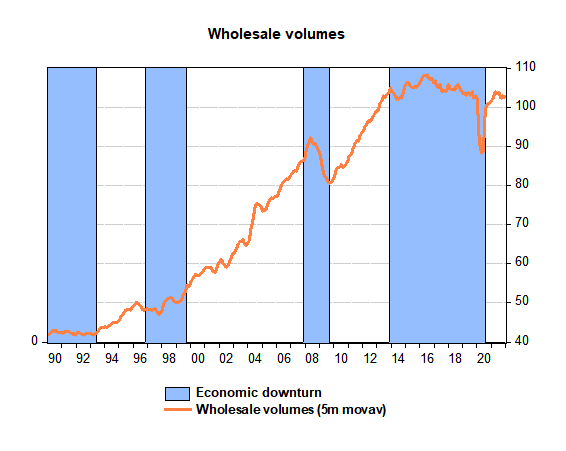
On the demand side of the economy, the hit to retail & wholesale during 21Q3 is evident in a 2.4% contraction in real household consumption expenditure. Gross domestic fixed investment remained flat, continuing to hover close to 12% below pre-COVID levels. Inventory disinvestment also continued during the third quarter, albeit that some bottoming appears to be underway. The export sector was also hit, with volumes contracting by a massive 5.9%.
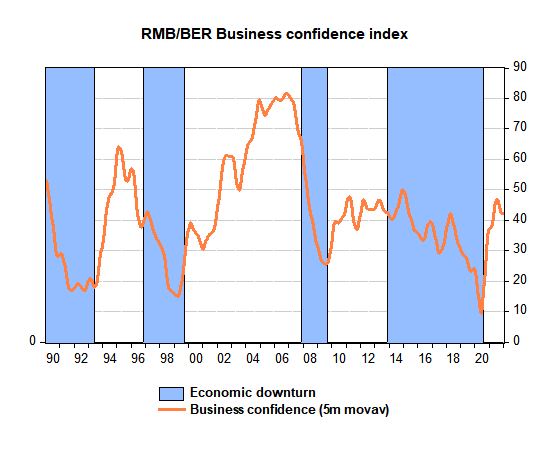
The overall decline in business confidence during 21Q3 was relatively contained as the plunge was limited to KZN. The RMB/BER confidence index remained flat during the fourth quarter of the year. While building & construction activity are benefiting from reconstruction efforts in KZN, the economic outlook has been clouded by developments in the tourism sector following the identification of the Omicron variant of the coronavirus. Intermittent electricity load shedding also continues to bedevil economic growth and the outlook.
Whilst the economy continues to recover from COVID, the 21Q3 unrest in KZN and Gauteng was a setback – overall GDP remained 2.9% below pre-COVID levels during 21Q3. Excluding external trade, real domestic spending was 4.0% below pre-COVID levels.
The fourth COVID wave will likely dampen activity, but the scope remains for the economy to continue recovering – it has some way to go to enter an expansion phase. The likely lower turning point was August/September 2020 according to the recession-dating algorithm.
In sum: the business cycle
The current trough-to-trough business cycle peaked in November 2013. There were signs of a bottoming towards the end of 2016/early 2017, but this failed to materialise. Following the COVID-19 induced plunge in activity during 20Q2, the economy rebounded strongly.
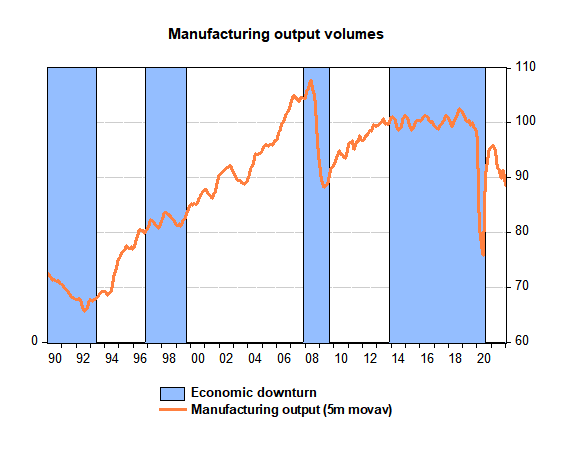
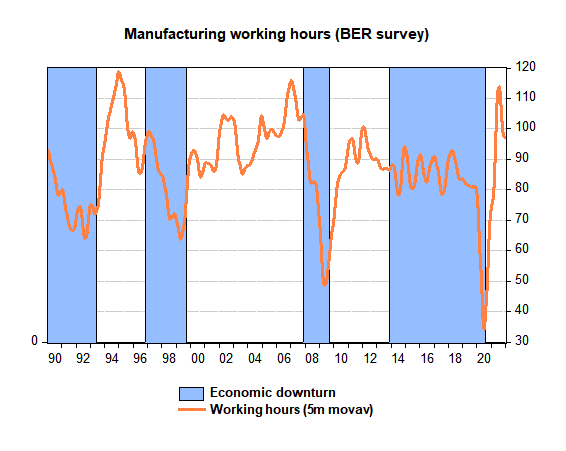
Three components of the algorithm registered LTPs, clustering around August/September 2020, i.e. business confidence, manufacturing output and working hours. This may be signalling the formation of a proper LTP in the business cycle, but it remains too early to call.
The latest tendency in manufacturing output is ominous (see chart), albeit influenced by the KZN looting; the improvement in the sector is limited to a strong recovery in working hours. This indicator also took a hit, but remains elevated. The likelihood remains for the economy to continue recovering from the COVID shock.
“When you adopt a cyclical worldview, your outlook will be in the minority whenever the chance of an economic turning point is high”
Achuthan & Banerji