

ECONOMIC RECOVERY MOMENTUM SLOWS 21Q1, BUT CUMULATIVE REBOUND IS STRONG
Real GDP continued to recover during 21Q1 from the COVID-19 induced plunge (16.6%) during the second quarter of last year. Even revised somewhat lower, the recovery came in stronger than expected during the second half of last year (13.7% and 1.4% respectively during the third and fourth quarters) and during the first quarter of 2021 (1.1%). The faster than expected recovery is heartening.
Real GDP is still 2.7% down on levels a year ago, i.e. before economic lockdown. This makes it clear that the economic recovery has not yet entered its ‘expansion’ phase. Furthermore, despite being more rapid than expected, the recovery momentum slowed somewhat during the first quarter of 2021. To some extent this was to be expected in view of the second COVID-19 wave and its associated lockdown measures in January. Countervailing growth in the agricultural sector (particularly last year) has been an important factor in the recovery. A second factor, which emerged strongly during the first quarter of 2021, is the boost in mining output linked to the global economic recovery and surge in commodity prices. The level of primary sector GDP (agriculture and mining) measured 6.3% above levels a year ago.
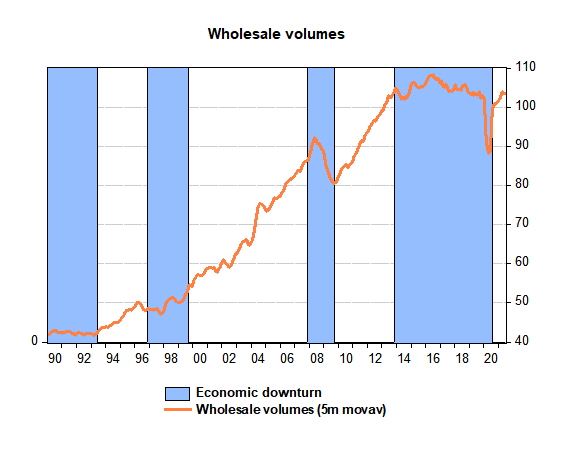
A third notable factor – on the demand side of the economy – is the resilience and willingness of consumers to spend in the face of the pandemic onslaught. Real household consumption grew by 1.1% (quarter-on-quarter) during the first quarter and is only 1.3% beneath levels a year ago. This supported the continued first quarter recoveries in the retail, wholesale & accommodation (1.5%), financial & business services (1.8%) and transport & communication (1.2%) sectors. Some manufacturing sub-sectors also benefited.
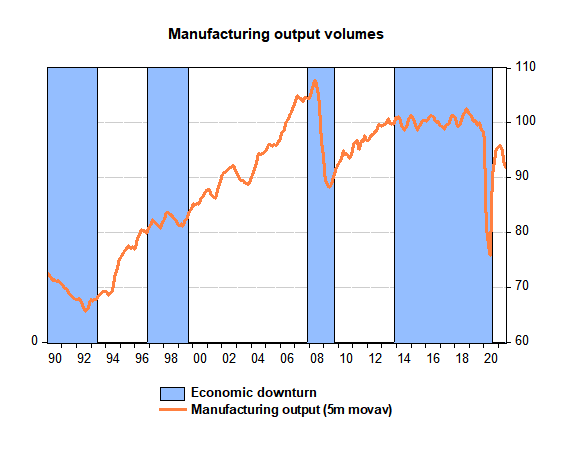
However, the first quarter recovery in manufacturing disappointed somewhat, with real GDP growing by only an additional 0.4%. Much of the new spending was imported. Real imports jumped by more than 6% during the first quarter in response to the 12% jump in real domestic expenditure.
Real exports actually contracted somewhat following its strong recovery during the second half of 2020. The fact that real gross domestic fixed investment also contracted (by 2.3% in the private sector) suggests it not being a factor in the import boost. It is also sobering to note that real private sector investment remained close to 22% down on its 19Q4 level.
For the current economic recovery to evolve into a more meaningful expansion, fixed investment has to revive. Public sector fixed investment did grow by 3% (quarter-on-quarter), albeit important to note that public corporation capital spending is still 30% below levels a year ago.
Pent-up fixed investment spending is clearly a strong potential growth factor. Likewise, depleted inventory investment levels. Pent-up (long-term) fixed investment demand (e.g. infrastructure fixed investment) is an autonomous growth factor. Measures, such as the regulatory changes regarding electricity supply and others (including anti-corruption drives) aimed at policy certainty and credibility have huge potential in unlocking economic growth. Of all challenges and economic constraints, the electricity supply shortages are the most binding.
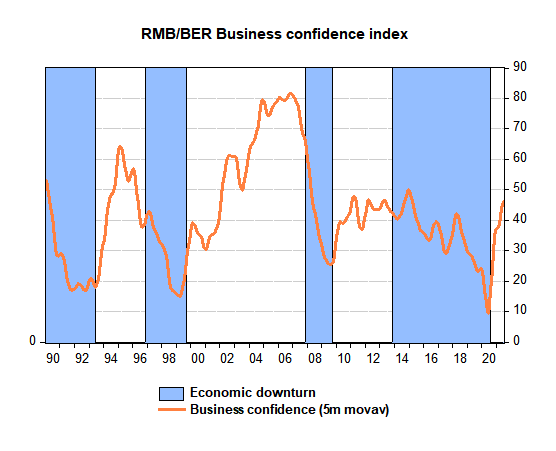
The RMB/BER Business Confidence Index jumped 15 points during the second quarter, with activity levels in retail, wholesale, manufacturing and motor trade livelier than expected. These results also suggest economic growth may be more resilient during the third COVID-19 phase.
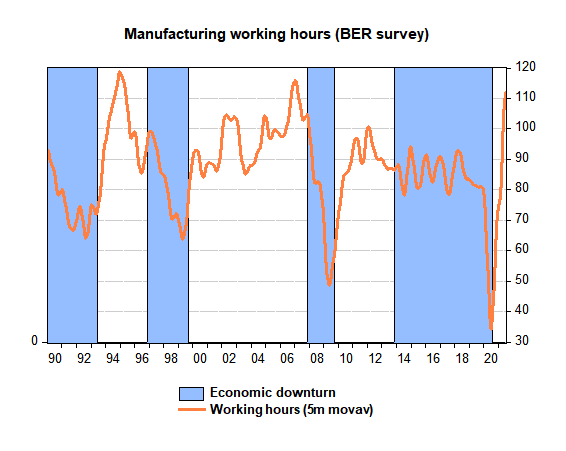
All this points to critical momentum on the demand side of the economy, which is also supported by the economic impetus from abroad. The supply-side of the economy, particularly the secondary sectors, are lagging at this stage. Furthermore, the growth in spending levels need to be sustained to ignite capital spending and employment before the economic recovery will gain endogenous momentum.
In sum: the business cycle
The economic downturn from the end of 2013 witnessed a tentative lower turning point (LTP) mid-2016; however, failed to shift into a sustained upturn. The algorithm suggests the economy reached a ‘downward inflection point’ towards the end of 2018, with the lack of momentum causing the economy to begin sliding. Real GDP began contracting during the third quarter of 2019. By March 2020, ahead of the COVID impact, all components of the recession-dating algorithm entered recessionary territory.
This preceded the precipitous fall in economic activity during the second quarter of 2020 when economic lockdown stalled almost all economic activity. By the first quarter of 2021, all components of the algorithm have rebounded; however, with no indication yet of an LTP. Two of the components of the BER’s recession-dating algorithm have registered lower turning points, centring during the second quarter of 2020. It is too early to make a call regarding the end of the historic downturn. The evidence of a proper LTP shaping grew stronger though.
The SA economy may have embarked on a recovery, with the potential to develop into a sustained expansion. All hands should be on deck in capitalising upon this opportunity.
“When you adopt a cyclical worldview, your outlook will be in the minority whenever the chance of an economic turning point is high”
Achuthan & Banerji