

THE ECONOMIC RECOVERY MOMENTUM SLOWS SHARPLY, 20Q4
Real GDP continued to recover in the fourth quarter of 2020 (1.5%, quarter-on-quarter) following the precipitous fall in the second quarter (16.6%) and the rebound in the third quarter (13.7%). Cumulatively, the rebound of economic activity during the second half of 2020 was slightly stronger than anticipated, helped along by favourable climatic conditions and agricultural yields. The level of real agricultural output ended the year 21% above that of a year ago, adding 0.2 percentage points (directly) to the annual GDP growth rate. It softened the contraction in GDP for the full year to 7%. However, it is clear that the recovery momentum has slowed sharply during the fourth quarter. On the production side of the economy, the secondary sector (consisting of manufacturing, water & electricity supply and construction) was impacted the most severe due to the economic lockdown. Real output in these sectors contracted by 12.5% for the full year, compared to contracting slightly more that 5% in the primary and tertiary sectors respectively. This is to be expected given the secondary sectors’ wide linkages with the other sectors in the economy and the supply chain and logistical issues which arose during lockdown and the implementation of travel restrictions. Two other subsectors were also impacted heavily, namely construction (output contracted by more than 20%) and the transport & communication sector (-14.8%). The annual contraction was above average in these sectors and manufacturing (11.6%), mining (10.9%) and retail, wholesale & accommodation (9.1%).
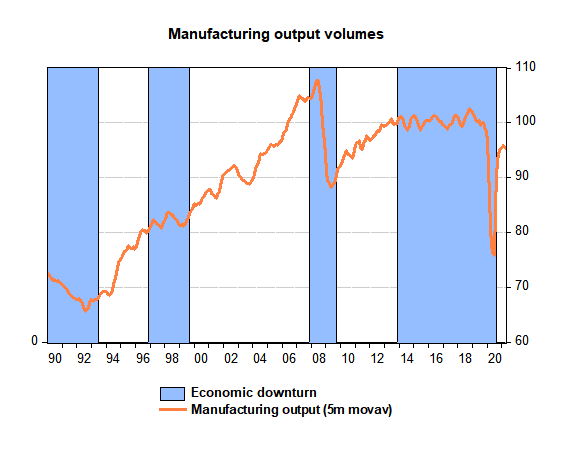
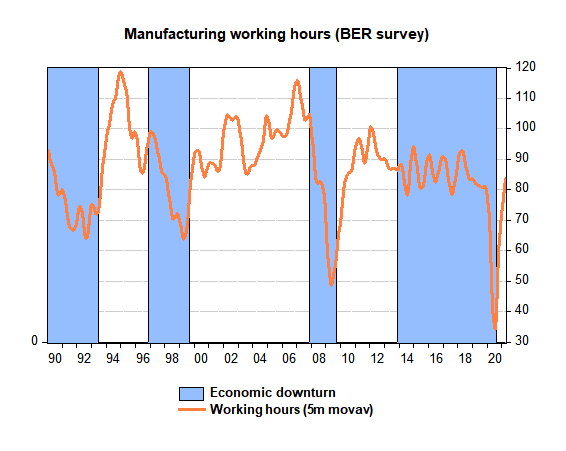
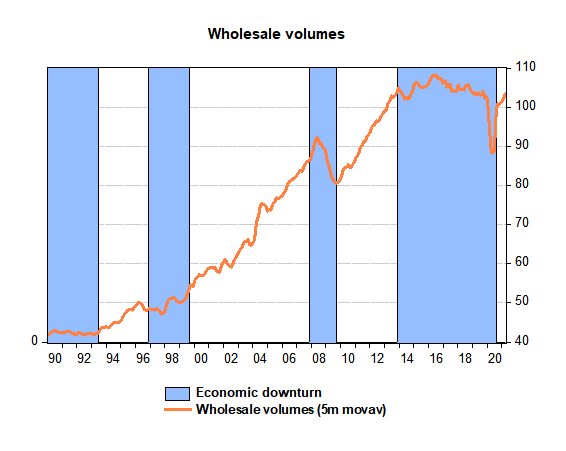
The manufacturing recovery was quite strong during the second half of the year. Following the dramatic 29% contraction during the second quarter, it rebounded by 33% in the third quarter and a further 4.9% in the fourth quarter. Manufacturing output was only 3.2% down from levels at the end of 2019. Most sectors are on the recovery road, with agriculture, the government and personal services having attained output levels before the pandemic impact (or better). Overall GDP is still 4.2% below levels a year ago.
On the demand side of the economy, aggregate spending recovered by 2.7% quarter-on-quarter, taking the overall level of real domestic spending to 6.9% below levels a year ago. Net exports therefore continue to explain a large part of the GDP recovery, albeit that the balance shifted noticeably during the fourth quarter. Final demand picked up and imports accelerated.
In sum: the business cycle
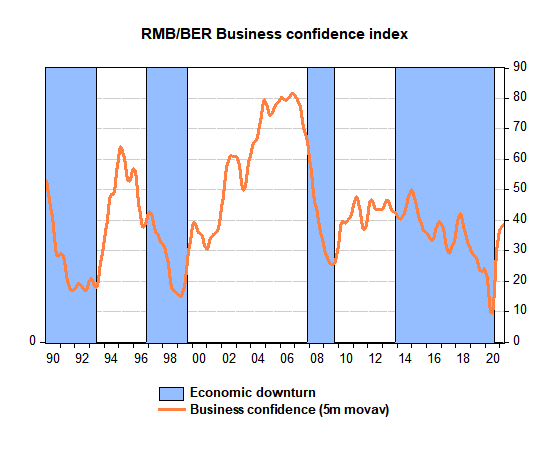
The economic downturn from the end of 2013 witnessed a tentative lower turning point (LTP) in 16Q4; however, failed to shift into a sustained upturn. The algorithm suggests the economy reached a ‘downward inflection point’ (18H2), with the lack of momentum causing the economy to begin sliding. Real GDP began contracting in 19Q3. By March 2020, ahead of the COVID impact, all components of the recession-dating algorithm entered recessionary territory. This preceded the precipitous fall in economic activity (20Q2). By 21Q1, all components have rebounded; however, with no indication yet of any LTP.
Only business confidence troughed in January 2021. It is too early to make a call regarding the end of the historic downturn. Supply chain bottlenecks (e.g. raw material shortages at manufacturing level, import constraints, etc.) related to lockdown measures may hinder the usual propagation of cyclical forces in the economy at this juncture
Going forward, an important determinant of the GDP recovery will be to what extent domestic manufacturers supply the anticipated catch-up in imports. At the end of last year the level of imports was still 12.8% below that of 2019Q4. A large part of the slump in imports is explained by the heavy inventory disinvestment that occurred as the economy came to a standstill. The recovery in final demand is dominated by household spending; that in fixed investment remains disappointingly slow. The level of fixed investment was still 17.2% below that of a year ago. While business confidence did fall back by 5 index points during the first quarter of 2021, this was expected in view of the sharp jump during the second half of 2020 and the re-institution of restrictive measures in December/ January. To what extent business confidence will be boosted in the coming quarters will be a strong determinant of the pace of economic recovery.
In this regard, initiatives in the infrastructure investment department, measures to boost domestic manufacturing (by replacing imports) and the generally expected global economic recovery bode well. Needless to say, the level of uncertainty remains profound.
“When you adopt a cyclical worldview, your outlook will be in the minority whenever the chance of an economic turning point is high”
Achuthan & Banerji