

WEAK DEMAND CLOUDS THE OUTLOOK, 23Q3
SA’s post-COVID economic recovery has evolved to a precarious state. The pattern of rigid growth, characterised with an erratic quarterly pattern, continues. Ironically, the combination of a reprieve in electricity loadshedding (real value add up 0.2% in 23Q3) and a more competitive currency (undervalued by 4.2% on average) is holding up the supply-side of the economy.
The ominous development has been the sustained and somewhat accelerated weakening of general demand conditions in 23Q3. Real domestic expenditure contracted by 2.9% and ended slightly below pre-COVID levels (2019). Compared with the level a year ago, it is down by 1.4%. The fact that imports shrunk in symphony with domestic spending and export growth remained positive, explains why overall GDP is still up on pre-COVID levels, by barely one percent.
On the supply-side, the rigidity of economic growth is illustrated by the fact that non-agricultural GDP remained flat, both in 23Q3 and compared to levels a year ago (only up 0.1%). Real agricultural output is contracting in the wake of the favourable 2022/23 season. The level is down close to 10% in 23Q3 and slightly more than 20% compared to a year ago. This subtracted and explained the 0.2% contraction of overall GDP. Sustained expansion in services GDP countered renewed contractions in the cyclically sensitive primary and secondary sectors, as well as in retail, wholesale & accommodation.
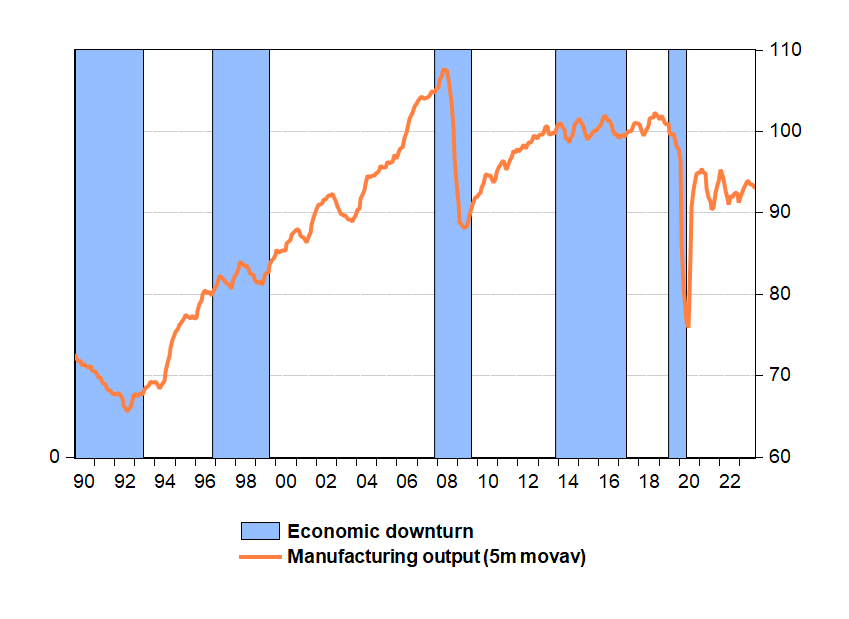
Mining GDP (down 1.1% in 23Q3), manufacturing (1.3%), construction (2.8%) and retail, wholesale & accommodation (0.2%) all remain well below pre-COVID levels. These sectors are respectively down by 9.7%, 5.5%, 22.4% and 4.3% versus 2019 levels.
Services GDP is still 4% up, but the growth momentum is receding in synch with broad spending in the economy, peaking towards end-2022/ early-2023.
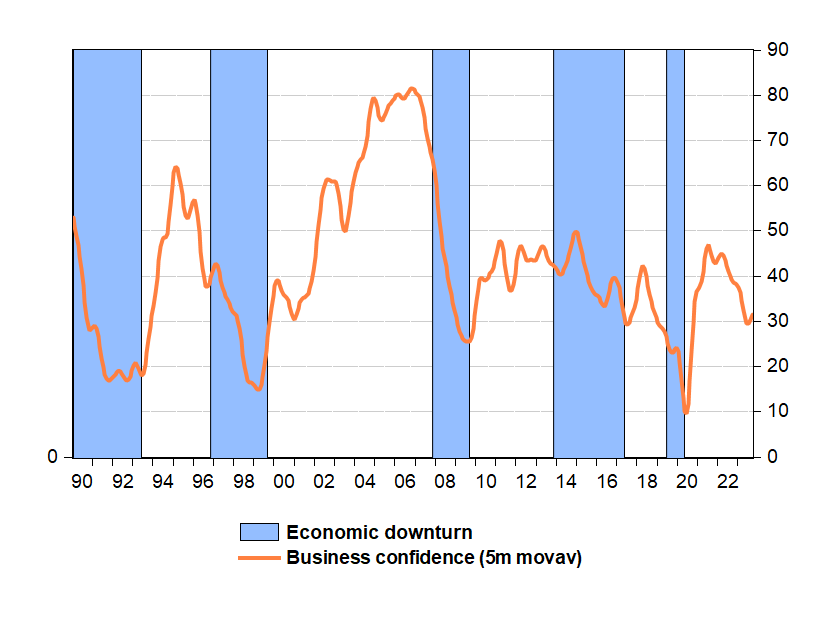
On the demand side of the economy, the measure of resilience detected previously may finally be giving way to the severe pressure of high interest rates, the serious lack of job creation and high uncertainty. Not even strong counter-cyclical government consumption spending changes this reality. Consumer confidence drifted weaker in 23Q3. Real household consumption contracted by 0.3%, peaking towards end-2022/early-2023.
Of greater concern is that capital spending in the renewable energy sector, boosting growth in 23Q2, could not prevent a 3.4% contraction in GDFI. From a low bottom, GDFI is still 3.6% up from year-ago levels. This is the strongest expenditure component of GDP but remains 6.8% beneath pre-COVID levels. The contraction in public sector fixed investment is worse compared to the private sector.
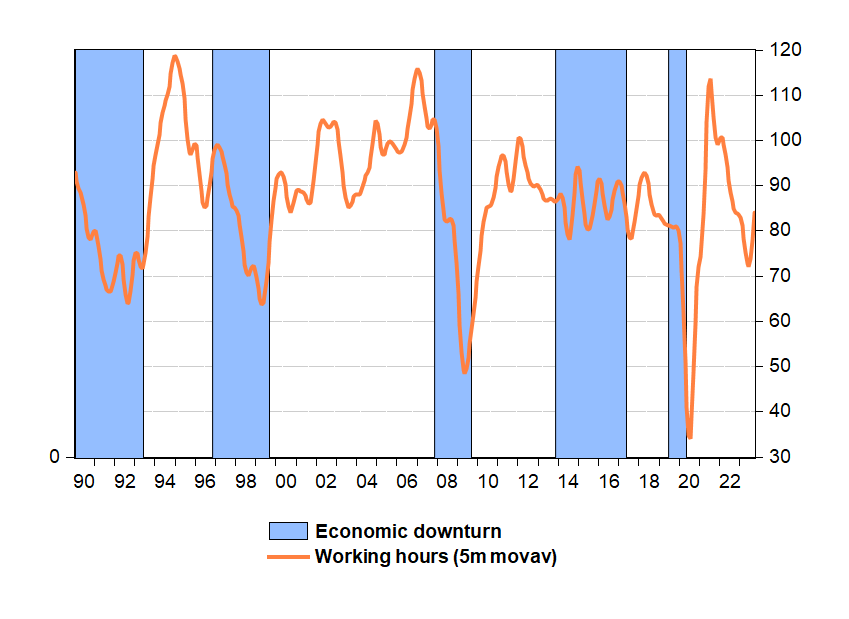
Fourth quarter economic indicators largely extend the existing tendencies. Some ‘resilience’ is detected on the supply-side of the economy. Mining volumes picked up in October (2.1% mom) and real manufacturing output contracted marginally (0.2% mom) but are up 2.1% yoy and 0.2% (year-to-date). BER survey results in respect of 23Q4 reported a sharp jump in factory working hours (chart), and improvements in domestic and export sales and output levels, including an uptick in confidence. The building sector reported improvements throughout the value chain, both in activity levels and sentiment. The civil construction sector reported a small uptick in activity, but sentiment slightly lower.
The important caveat in the positive supply-side developments, is the fact that the outlook is less upbeat, with order books – in manufacturing, building and construction – under increased pressure. The November PMI readings revealed increased strain in the manufacturing sector owing to port congestion and consequent constraints in supply chains. Electricity output increased in October, but Eskom’s EAF is down, clouding the outlook.
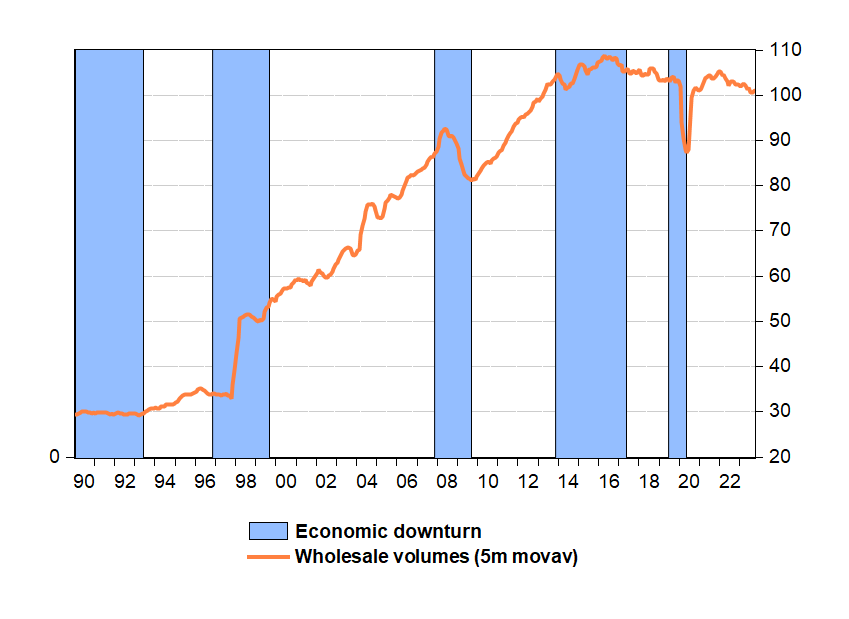
This reflects the weakness in general demand conditions. Retail- and wholesale activity levels were under pressure in 23Q4 according to the BER survey results; new vehicle confidence and sales (a leading indicator of household spending) tanked. Stats SA reported that October retail sales volumes continued to contract, 1.2% (mom) and 2.5% (yoy), confirming the BER’s forward-looking evidence. Real wholesale volumes are on a downward trajectory (chart).
The business cycle[1]
The evidence on the international economy is quite conclusive, pointing to slower growth, lower inflation and interest rates. Disinflation in the Euro Area has progressed further than in the US and growth is also weaker. PPI inflation is deeply negative, CPI inflation at 2.4% in November (core at 3.6%); the ECB has formally announced the end of interest rate hikes. China’s growth is also under pressure, albeit that the Central Bank is, amidst a property crisis and debt scares, going full-on in stimulating the economy. World trade volume growth already reached a recessionary low of 3.2% in July. The BoJ is considering interest rate increases following the successful reflation of its economy. Most disturbingly, the wars in Ukraine and the Middle East are seriously damaging commodity supply chains and complicating the green transition (IMF WEO, October 2023). According to the IMF, its medium-term outlook for world growth is the lowest in decades.
Against this global backdrop, trajectories of the SARB’s composite business cycle indicators (see charts), the decline in the RMB/BER Business Confidence Index to 31 points in 23Q4, the contraction in broad domestic demand and, of late, the US interest rate pivot (see below) do not bode well. SA’s business cycle is poised at a critical level where growth may slow to a point below pre-COVID levels. Some components of the BER’s recession-dating algorithm indicate a tentative peak in economic activity shaping during the second half of 2021/ early-2022.
The levels of uncertainty remain radical. A stronger currency may weaken the supply-side of the economy and the electricity supply situation remains critical, despite some easing in recent months. The MPC was unanimous regarding putting interest rate hikes on hold; it is to be hoped the inflation outlook will soon provide scope for an even more accommodative stance.
FOMC signals interest rate pivot at December meeting
Whereas it was difficult to assess the state of the US business cycle over the past year or so, the picture has moved. The fog created by the conflicting signals from headline news on the US economy and the unfolding fundamentals, has cleared somewhat. Yes, November payroll employment remained strong (but driven mainly in services), 23Q3 GDP growth (3% yoy), lower-than-expected inflation, aiding real incomes and underpinning consumer sentiment, are all painting an upbeat picture. When assessing the hard characteristics of the historical US business cycle, the picture looks increasingly stark.
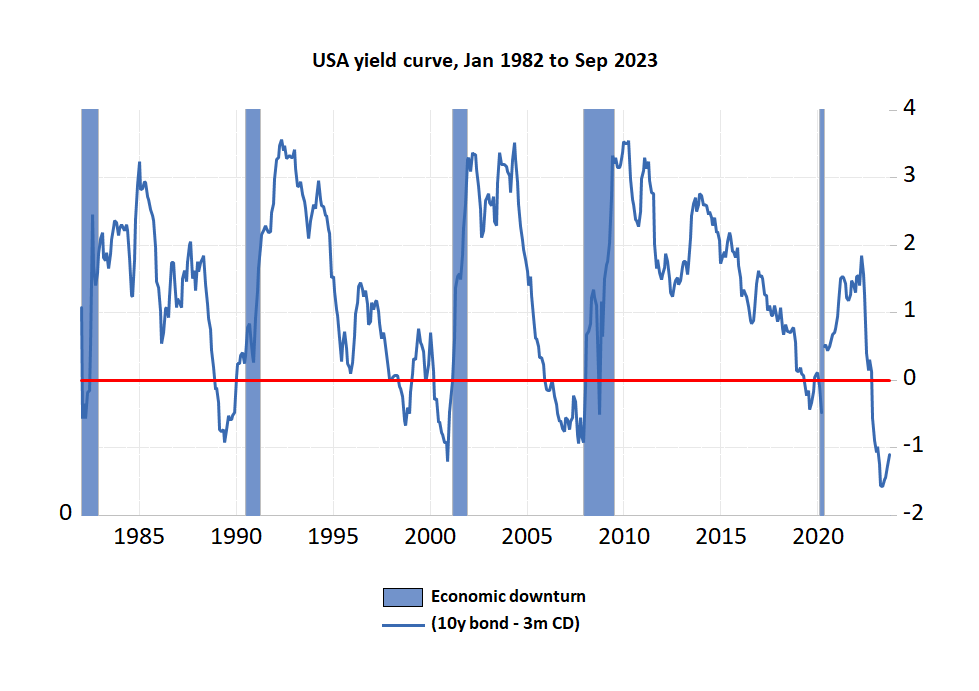
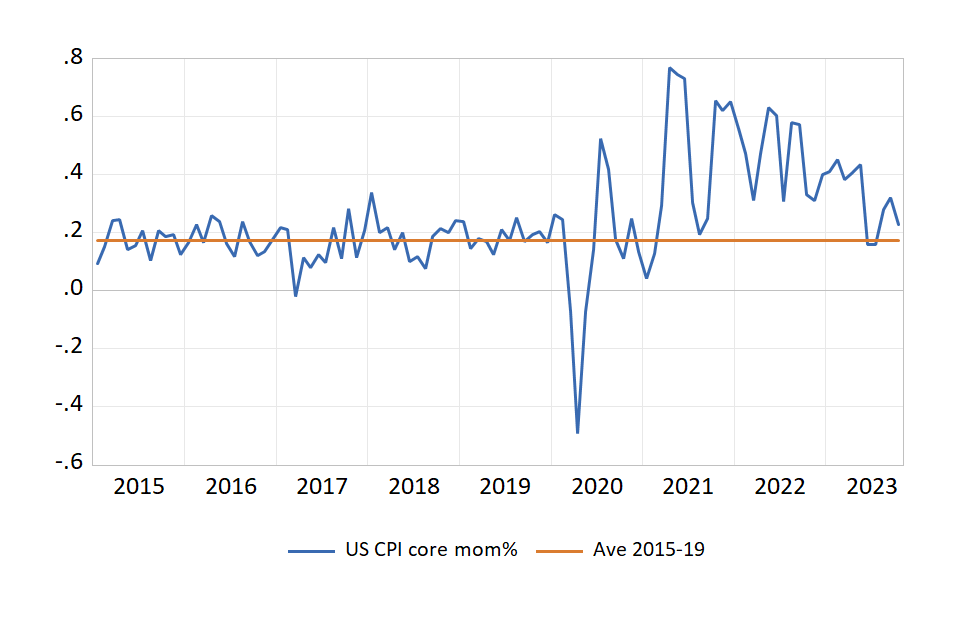
The yield curve inverted more than 12 months ago and is remarkably accurate in signalling a US recession. More of the hit to real consumer spending and retail sales of the spike in inflation and interest rates will become evident.
The same goes for disinflation, with CPI inflation most probably breaching the Fed’s inflation target sooner than the FOMC currently reveals in its guidance for monetary policy (see Hoisington, Quarterly Review and Outlook, 3rd Quarter 2023, pp.3-4).
Quantitative tightening is causing real back credit to contract; and fiscal policy has no other way than to tighten, given the savings-investment balance in the US economy. The scene is set for a bullish US capital market (read: declining long bond yields), driven by the bearish real economic growth outlook and inflation expectations.
[1] BCA hereby wishes to acknowledge that the recession-dating algorithm was designed and developed at the BER, Stellenbosch University.
“When you adopt a cyclical worldview, your outlook will be in the minority whenever the chance of an economic turning point is high”.
Achuthan & Banerji