

JUST AS THE SA ECONOMIC OUTLOOK BRIGHTENS, DARK CLOUDS DESCEND (25Q1)
SA’s financial markets were shaken by events during 25Q1 and early-April. Developments since 2 April (declared ‘Liberation Day’ in the US) created untold uncertainty, for policy makers, business executives and households alike.
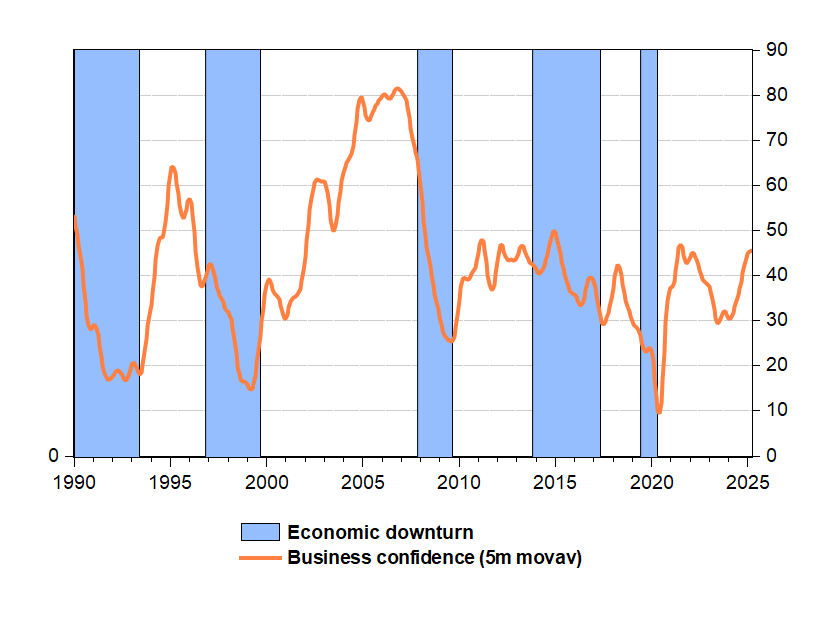
The formation of the GNU (Jun’24), the associated lift in business and consumer confidence and the improvement in retail, wholesale and vehicle sales towards the end of the year brightened the outlook. Structural reform is also amidst much socio-political noise gradually, but surely, swinging into action.
Teething problems in the GNU put the outlook at risk. Combined with the onset of untold disruption in the global trading system, SA’s open and small economy is vulnerable. Business executives may be pulling to the sidelines again, while a more cautious mood engulfs consumers.
Deep analysis suggests that a new world order is being forged. The implication is that SA’s business cycle is exposed to shocks. The lift in business confidence flattened in 25Q1 and consumer confidence declined by fourteen index points. Developments since 2 April are likely to intensify these adverse tendencies.
An US (and world) economic recession will impact negatively by way of reduced export demand (trade channel) and capital flow reversals (financial account channel). SA’s hesitant economic growth pattern (‘two steps forward, one step back’) will be prolonged and could even end in recession.
SA’s economic policy makers’ resolve remains. Real non-interest government spending is being contained and redirected to infrastructure. The SARB will ensure price and financial stability, with exporters seeking new opportunities in the hostile global trade environment. The going will be tough. Tentative signs that the business cycle troughed during 23H2, following a peak (end-’21/early’22), may be in the balance.
A GLOBAL TRADE WAR UNLEASHED – US HEADING FOR RECESSION
We live in a period of profound change – at every turn, swept along in the new unfolding era. The business cycle is suspended, but only temporarily. The US remains the world’s largest and most resilient economy but may be heading for recession.
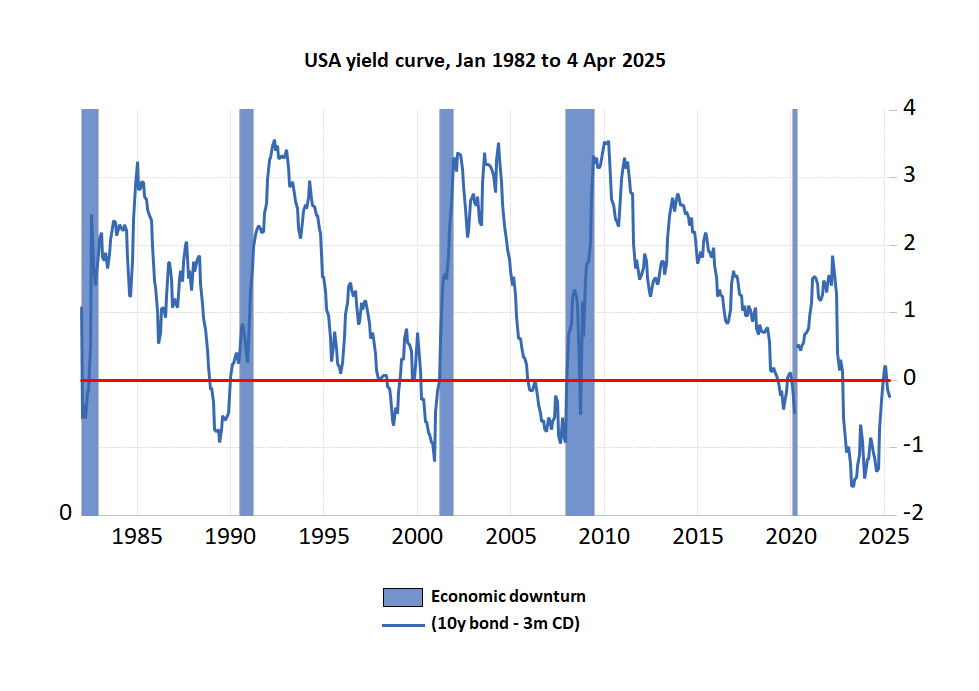
All high-frequency and leading economic indicators point to the fact that the US economy is beyond an upper turning point of its business cycle, the growth in payroll employment and real domestic spending continues, but at gradually receding rates.
Yet, this is not the principal factor. As a new world order is being forged, any country’s economic cycle is subject to abrupt change. A global tariff war was unleased on 2 April, with a welcome reprieve to non-retaliating countries for 90 days[1].
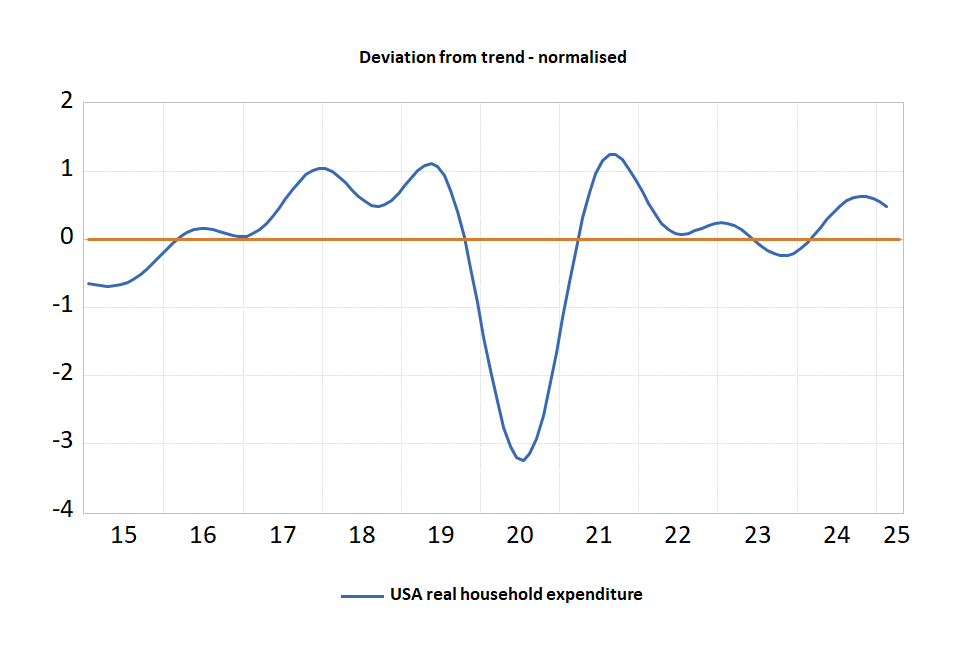
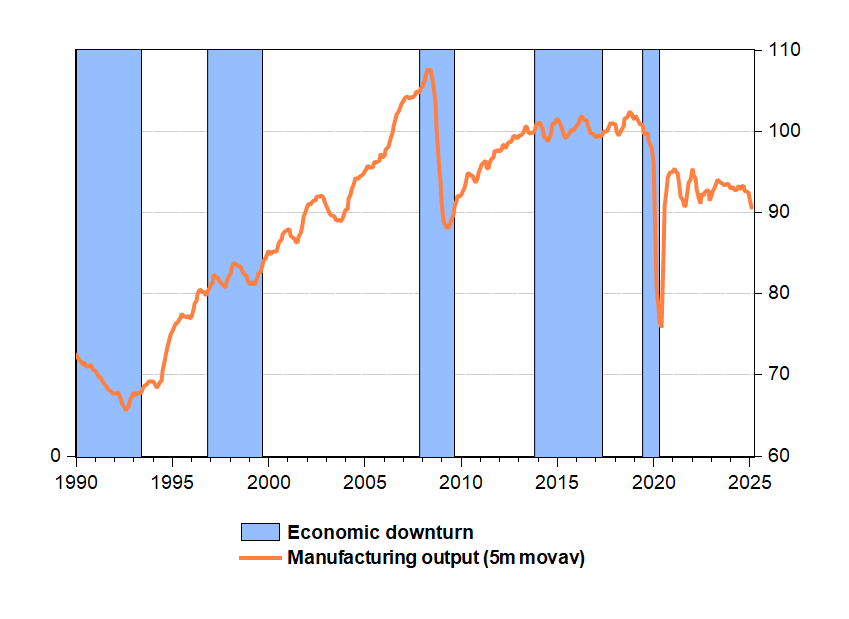
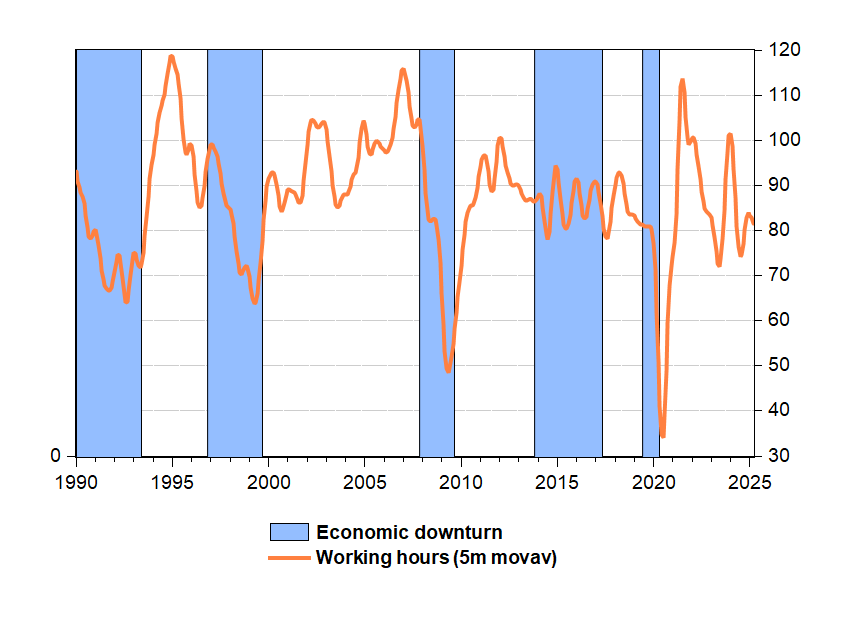
The charts reveal that the yield curve has long been signaling a US recession, non-farm payroll employment growth is tapering off and real household and private fixed investment spending growth are beyond cyclical peaks. Manufacturing output is already in ‘recession’ and overall GDP growth is topping out. Underutilised production capacity is not restricted to the US, but also evident in China, the EU, Japan and UK.


THE SA ECONOMY DISAPPOINTS AGAIN IN 2024
The release of the 24Q4 GDP figures, affords an opportunity to not only assess the latest economic momentum, but also economic growth during the previous year and over the past decade, 2015-24.
From a contraction in 24Q3, real GDP recovered modestly, growing by 0.6% in 24Q4. Two-thirds of this growth is explained by the rebound in agriculture real GDP (up 17.2%), having contracted by (an upwardly revised) 17.7% in 24Q3.
The recovery in agricultural GDP is heartening, but it could not prevent an 8% contraction in agriculture real value added during 2024. This followed on a close to 5% contraction in 2023. The 2020-22 recovery in the sector put it on a high base. While the cumulative contraction in 2023-24 was worse compared to 2015-16 (the previous serious contraction in the sector), the general production conditions were on a better level – the level of real agricultural GDP is 10.2% up on pre-COVID-19 levels.
These adverse forces are likely to mend slowly, but surely. All four broad categories of household consumption grew during the middle quarters of 2024 and this momentum received added support with the implementation of the two-pot pensions system on 1 September and the easing of interest rates and inflation.
Most disappointing, was the sharp contraction of private fixed investment as the earlier boost of investment in the renewables sector wears off. While government and public corporations’ infrastructure spend boosted the aggregate, the latter was still 11.4% down (24Q3) compared to pre-covid levels (2019). A sustained improvement in demand conditions will move businesses to invest and create employment.
Outside of agriculture, SA’s real economy stagnated for all intents and purposes – non-agricultural GDP expanded by only 0.2% (quarter-on-quarter) and 0.8% (year-on-year) in 24Q4 (and 0.8% for the full year).

Consistent with the pattern over the 2000s, it is the tertiary sector that drove growth, and more specifically, financial & business services. This sector expanded by 1.1% in 24Q4, 4.1% (year-on-year) and by 3.5% in calendar 2024.
Water & electricity’s woes reversed in 2024, expanding by 3.5% during 2024, following a cumulative contraction of close to 7% in the preceding two years. The 1.4% contraction in 24Q4 (quarter-on-quarter) is disappointing, indicating that we are not out of the woods yet as far as electricity supply is concerned.
A most remarkable fact of the latest GDP statistics is the fact that only three broad sectors accounted for all the growth for the year, i.e., financial & business services (up 3.5%), personal services (1.7%) and the recovery in the water & electricity sector (3.5%).
The growth in these sectors counterbalanced the contraction experienced in all the other major economic sectors, accounting for the marginal growth of 0.6% in real GDP.
Both the primary (-0.7%) and secondary (-2.9%) sectors contracted, compared to 1.2% growth in the tertiary sector. Mining (up 0.3%) and government (-0.1%) sectors stagnated in 2024.
Two prominent features of SA’s economic growth performance last year, is the continued slide in the manufacturing sector’s contribution to GDP.
The sector contracted by 0.5% in 2024. It lost momentum towards the end of the year, a tendency which did not reverse in 25Q1 according to high frequency data. Secondly, the steep contractions in construction (5.1%), internal trade (1.4%) and transport & communication (1.3%) reflect the recessionary economic conditions.


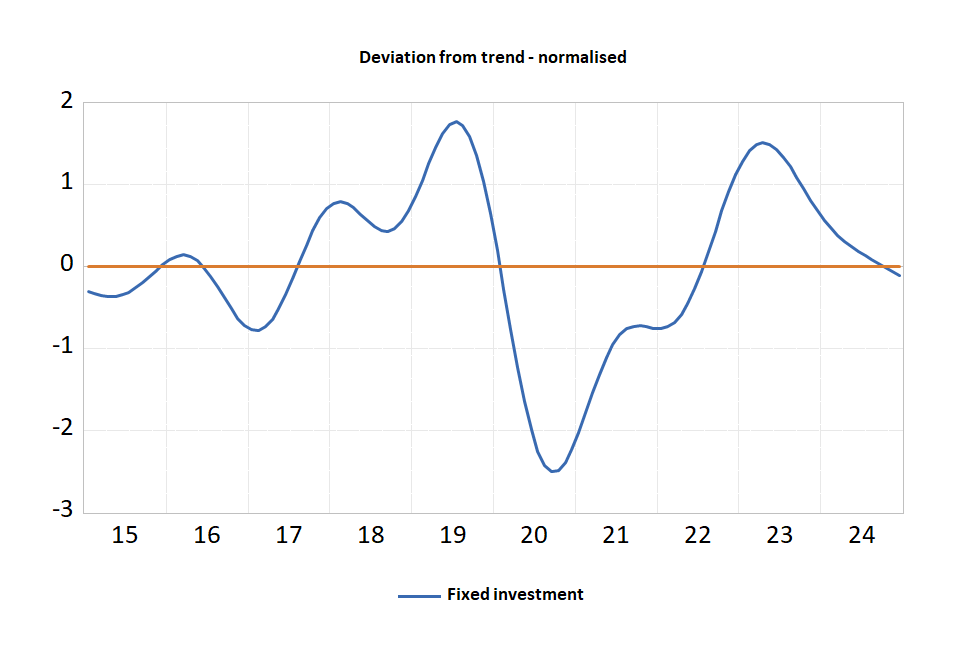

The recovery in real domestic spending during 24Q4 was heartening, but too modest to prevent a 0.7% contraction for the full year. The domestic market began losing its cyclical momentum from the early part of 2023 (see charts).
Both real household and fixed investment expenditure cooling down sharply. Gross domestic fixed investment contracted by no less than 3.7% (mirroring the 5% contraction in the construction sector).
Even the countervailing force of net exports caved in towards the end of last year. The sad fact is that any growth in the SA economy remains dependent on household spending. Government’s share in GDP stabilised, but that of household spending continues to expand, with much of the spending imported.
The SA economy performed poorly in 2024. The recovery in the domestic market appears not to have legs and being not meaningful enough to stimulate fixed investment. There was some glimmer of hope, with private fixed investment growing by 1.5% (quarter-on-quarter) in 24Q4 and the consumer sector ending the year on a strong footing. These emerging tendencies need to be strengthened.
2024 COMPLETES ANOTHER ‘LOST DECADE’ FOR SA’s ECONOMY
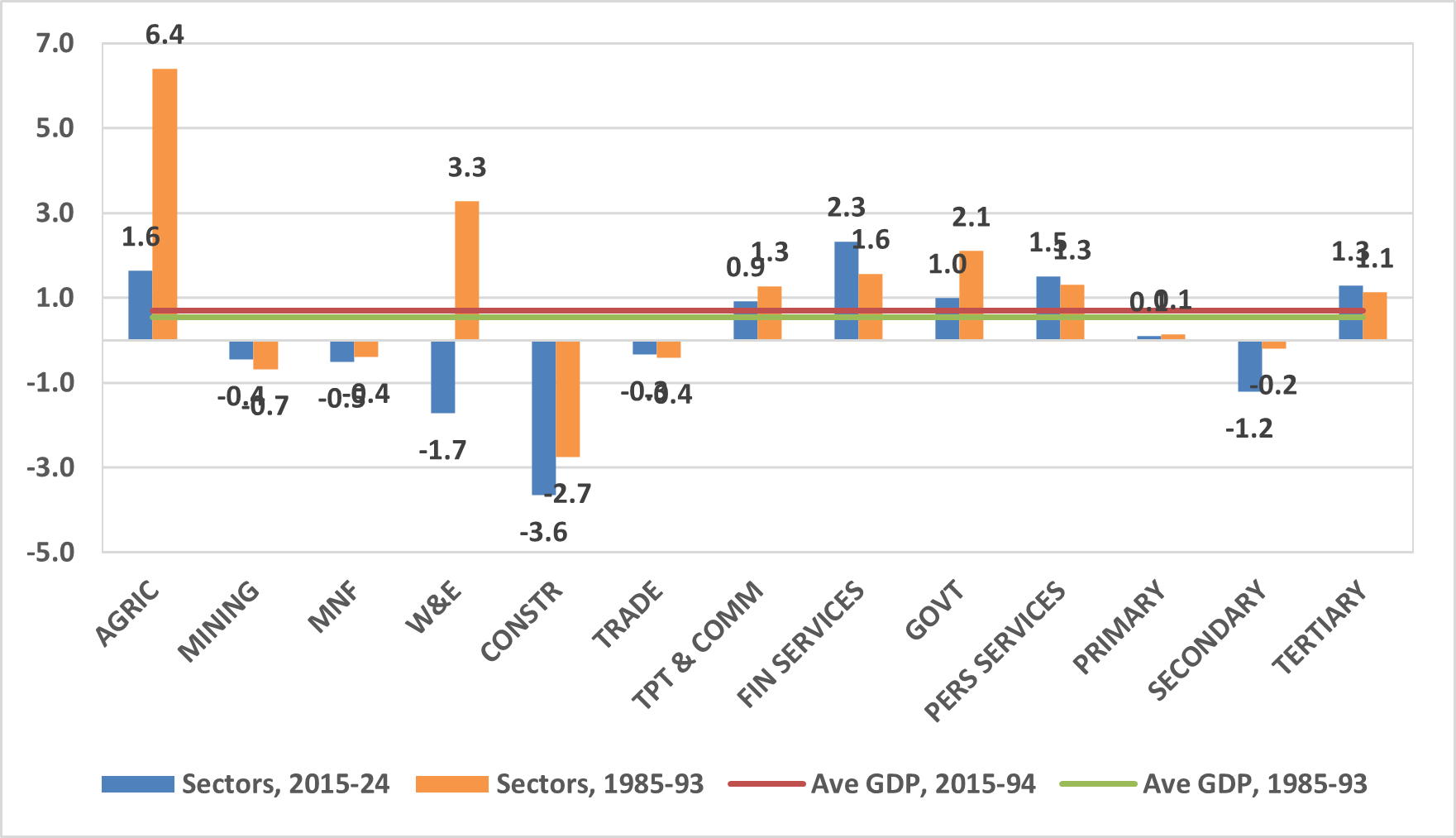
It is a simple truism, that without economic growth, SA will not achieve its commendable socio-economic ideals. SA’s economic performance, 1985-93 (at the apex of the apartheid economic crisis), and over the past decade, 2015-24 (with narrow-based BEE policies, inter alia, stifling economic growth) has striking similarities.
During both periods, real GDP growth averaged below 1% per annum. This was well below the population growth rate, implying a sad deterioration in living standards, or lower real per capita incomes.
The pattern of broad sectoral growth in real GDP during both periods is similar. On average, the primary and secondary sectors stagnated. It is interesting though, that during both periods, the agricultural sector was one of the strongest growing sectors, particularly during the 1980s. Unfortunately, the growth in agriculture was countered by the contraction in mining during both periods.
Manufacturing and construction also contracted during both periods, even more so over the past decade (despite active policy intent to reverse de-industrialisation). There was a stark contrast though – water & electricity real value added expanded strongly during the 1980s and contracted sharply over the past decade.
This, combined with the sharper contraction in manufacturing and construction explain the inferior performance of the secondary sector, contracting by 1.2% pa, 2015-24 (compared to a contraction of 0.2% pa, 1985-93).
The services sector led growth in both periods. During the 1985-93 period, government real GDP was the strongest performing services subsector (expanding 2.1% per annum), during the past decade, it was financial & business services (2.3%).
The steep contractions in the construction sector during both periods reflect poor fixed investment and infrastructure spending as capital budgets made way for government consumption (with private sector fixed investment being crowed out).
The key challenge for the SA economy, is to break out of this gridlock. With anaemic growth and a weak business cycle momentum, the economic outlook will remain grim. Alternatively, should the policy makers succeed in breaking this gridlock stifling economic growth, the medium-term outlook will brighten.
Initially, advances will remain difficult given the prevailing headwinds – a matter of two steps forward, one step back – but a rising economic trajectory will better withstand shocks, and in time, restore a proper business cycle momentum, with a decade of expansion likely to be materially different from that over the 2015-24 period.
[1] As emphasised previously, this report is concerned with the business cycle of the US and do not pretend to anticipate or foresee economic shocks. It would, however, assess the impact on the business cycle in case of a shock.
“When you adopt a cyclical worldview, your outlook will be in the minority whenever the chance of an economic turning point is high”.
Achuthan & Banerji