
The current low growth trap of the SA economy is a worry. Closer inspection reveals that both weak global growth and domestic supply side factors may explain the sluggishness in growth.
Globally, trend growth rates in both advanced and developing economies are being scaled down and growth forecasts are being adjusted downwards.
Excluding the recession rebound (2010-11), the growth tempo in the global economy receded to 3.3% (2012-15), from 5.1% per annum (2003-07, i.e. the five years before the Great Recession). In the advanced economies, the slowdown was from 2.8% to 1.5% per annum respectively and in the emerging and developing economies, from 7.7% to 4.7% per annum.
These growth performances are decidedly weak in a historical context and it has been suggested that the world has entered a period of ‘secular stagnation’. During previous centuries the world economy expanded in cyclical fashion around an ever rising (secular) growth trend. Currently, the expectation is that this long-term growth trend has flattened off. Informed analysts suggest that this is the ‘new normal’ for the world economy rather than being the exception or merely temporary. Some comparison can be found in the trajectory of Japanese nominal GDP since the late 1980s – see Figure 1.
Both demographic factors (ageing populations of Europe, Japan and – increasingly – China) and reasons related to lower productivity growth (maturing of the computer revolution) are rendering global growth weaker. The slowdown of economic growth is also occurring at the backdrop of climatic concerns and food, energy and water supply constraints.

Figure 1: Japan’s nominal GDP, 1980 to 2015
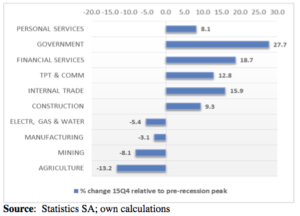
Figure 2: Economic recovery across sectors in perspective
Domestically, it can be postulated that due to the openness of the SA economy (64% of its GDP is traded internationally) that it will be impacted by the weaker global growth trend. Figure 2 reveals how the goods-producing sectors have been struggling in the wake of the Great Recession. SA’s real GDP growth slowed from 3.1% per annum during the 2010-11 rebound, to 2.2% during 2012-13 and 1.4% during 2014-15.
Unfortunately, the explanation does not stop there. By the end of 2013, when the SA economy entered a growth recession, the tradable goods sectors had not recovered to their pre-recession levels and have subsequently lost more ground during the recession. At the end of 2015, the level of real value added in the country’s agricultural (-13%), mining (-8%), utilities (-5%) and manufacturing sectors (-3%) were still below their respective pre-recession peaks.
The poor growth of electricity production reflects a key structural constraint in the economy and the drought took a toll on agriculture (its real value added declined by more than 8% during 2015). Other adverse supply-side factors, which impacted mining and manufacturing in particular, include intermittent periods of serious labour strife over the period since 2011, as well as economic policy uncertainty affecting business confidence. These supply-side constraints were important reasons for the onset of a growth recession in SA towards the end of 2013.
Pieter Laubscher
19 April 2016